I did a Mixergy interview so bad they didn't even release it // On making sense of our stories
Shortly after my first company had failed, somewhere around 2011 or 2012, I had a bit of useful stuff to share about custdev and sales.
What I didn’t understand was my own journey.
Which made for a real mess of an interview when Andrew Warner invited me onto Mixergy.
He politely interviewed me for an hour and a half, and then (I assume), took a deep breath, rubbed his furrowed brow, and hit that delete key.
And he was absolutely right to trash it.
Because although I was trying my best to share my honest experiences, it came out like a bag of marbles.
Flash forward five years, and I’m taking my little boat across France via canal, aiming for the Mediterranean:
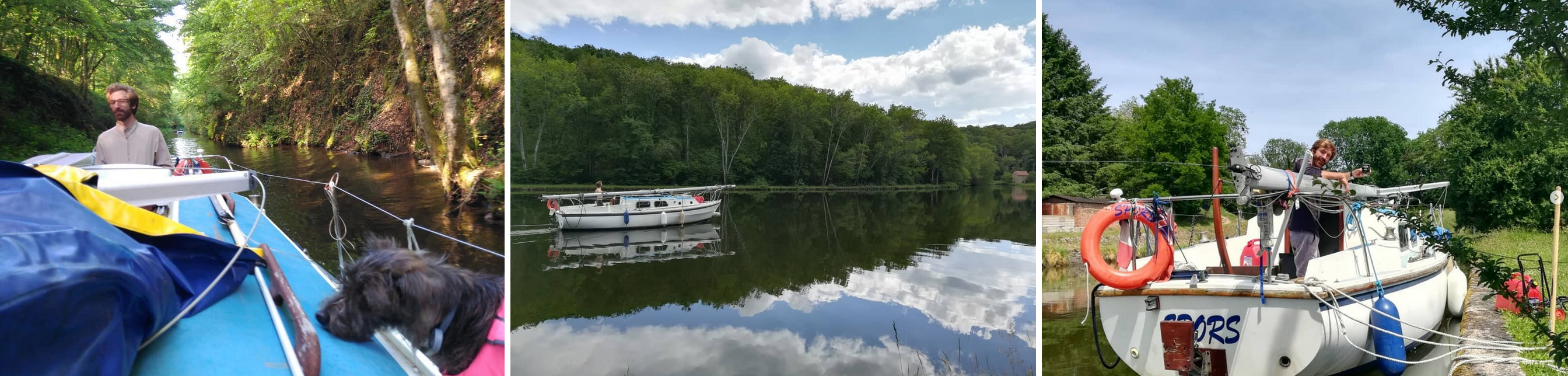
During this trip my health was in shambles. I’d spent the better part of a decade drinking my gut to the breaking point, and once the gut goes bad, the body and brain soon follow.
I’d taken an impromptu detour up the Nivernais Canal, beautifully wild, but shallow and overgrown. Spors wasn’t built for that sort of environment, and I found myself needing to jump into the water every 20 minutes with a knife, feeling through mud-dark water to cut the tangled plants and brambles off my propeller shaft.
(Also, the Nivernais is an old logging canal that was dug to get lumber down a mountain, so its whole deal is that it’s a canal that climbs a mountain. Gaining that altitude means working through 120 antiquated, hand-cranked locks. These locks are a pleasant pause with a crew to share the work, but they’re grueling labor while single-handed.)
With all that, plus my health, I was needing to take two days’ recovery between each day of travel. Then my engine broke in a pretty irreparable way, snapping a niche piece and thereafter spewing five liters of diesel per hour into my hold. Which wasn’t ideal, since the masts were down and I needed that fuel.
I limped the boat far enough to reach what might charitably be called a village, where I was able to order a replacement part to arrive in a few weeks. Still, there was a decent enough cafe nearby, so I got hold of a ream of blank paper, found myself a table, and spent ten hours a day writing my experiences so far, fumbling toward some sort of attempt at making sense of it all.
In the end, I wrote a couple hundred potentially interesting pages, a sort of memoir-slash-business book.
Unfortunately, the whole manuscript later ended up sinking with my boat.
The boat was recovered, the stack of paper not so much. But that’s okay, because the point was never about the words.
The point was about spending the time to understand my own story. To find the thread that connected it all. To assign some sort of coherent meaning to what otherwise appeared to be grab-bag of fuckups and misfortunes.
Once I understood it for myself, I also became able to start extracting the value for others. (And ever since, nobody else has thrown away one of my interviews.)
The funny thing here is that I’m 100% aware that our stories are wrong. Our own stories, doubly so. We back-fit narratives. Our minds rewrite what we remember thinking at the time.
So our stories are wrong. But they still matter.
Our personal stories are how we make sense of it all. In a difficult world, that sense of a consistent thread, of a purposeful journey (no matter how meandering and roundabout) is paramount.
Those couple weeks that I spent writing a soon-to-be-destroyed manuscript were among the best of the trip. Thank goodness that my health was bad, the journey hard, and that my engine broke, because it forced me to take the time.
Comments (4)
This story makes my heart sing, hearing you describe the value of doing the work to understand our own stories. Your self-effacing humor comes through so well in this piece. Thanks for inviting us into your world. (And now I get the story of losing your manuscript when your boat sank!)
Aw, thanks Marjorie :). Wonderful to see you here and thanks for the encouragement!
It was January 2012. Your story was amazing. I still have it. We just struggled to tell it.
I take responsibility for it.
I learned a lot since then about helping entrepreneurs tell their stories.
Thank you for trusting me with a very vulnerable conversation back then.
You're a star Andrew, thanks :). And with that sort of attitude, I can completely understand why you're among the best in the game.