Why I dislike Circle's automated weekly digests, and why I'm re-enabling them anyway
Despite not especially loving Circle’s automated, weekly email digests, I’m reenabling them here (it arrives on Thursdays and you can disable it, if you’d like, via notification settings by toggling “weekly digest”).
This is partly due to my own newsletter neuroticism and partly due to the lifecycle stage of this site and the sub-community within it.
Auto-emails and vanity engagement
The reason I dislike the auto-digests is that they’re (somewhat inevitably) designed around driving and showcasing engagement. But engagement is the wrong metric for community. Engagement is an ambiguous target in the sense that it can point just as easily toward deep, meaningful conversation (engagement-as-signal) as it can toward superficial, surface-level bike-shedding (engagement-as-noise).
Engagement, for most communities, is a goldilocks metric: wrong to have too little but *also* wrong to have too much. Engagement is “just right” when it’s sitting somewhere in the murky middle:
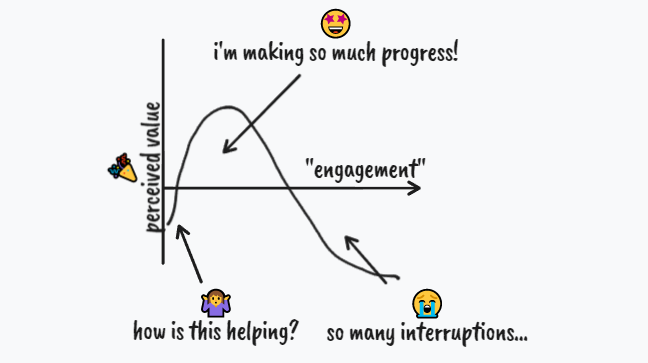
Auto-digests have a bad tendency to highlight the wrong stuff (i.e., amplifying engagement-as-noise) while also attempting to generate the wrong result (i.e., generating clicks such that numbers go up).
That’s basically fine for the public, bloggy bit of this site. The auto-digests aren’t so far off of my intention to [[market like a fruit tree]], where the stuff I create is on display and up for grabs, but without being pushed on or promoted to anyone.
However, it’s somewhat more problematic for the private community portion, where I believe in following the local newspaper rule of “names, names, names,” treating the email heartbeat as a means to amplify member progress, build a sense of collective momentum, and reinforce the beliefs and behaviors that make us us.
Still, I have evidently decided to re-enable the weekly auto-email anyway. (Notifications for individual posts are still disabled by default wherever possible.)
Which all raises the (very fair) question of why I’m re-enabling a feature that I largely disagree with.
Lifecycle stage, system maturity, and prioritization
Over in the authors’ community, we’re still hand-crafting every email. But that group is far more mature and stable than this one. Which means, on the one hand, that the email *can* be designed. And on the other hand, that it *must* be designed, since it’s playing a specific and important role within that larger living system.
Whereas, in the little OOC group here, where it’s still all content and concierge, each week’s activity is different enough that the email ends up requiring a much bigger chunk of decision-making and deliberation, and thus a far higher time cost.
This would normally be fine, if not for my email hang-ups (see below) and the fact that I’ve now got five (!!!) major projects on my plate (bad upstream decision-making, I know), so I’m working with finite time and must prioritize how I use it.
Regarding those priorities for the OOC group here: there’s still an awful lot of systems-level work that I ought to be doing to move the thing forward toward stability: the knowledgebase, flywheels, onboarding, and so on. In terms of pure pragmatism, the benefits of an improving system seem worth the price of (temporarily) sub-par emails. Once the system is more mature, I can shift attention back toward bespoke emails.
My newsletter neuroticism
All of the above becomes exacerbated since I seem to have a rather large hang-up about sending bulk emails, which results in me twisting myself into knots and/or just not sending them at all.
This gives the emails a much higher time-cost (and stress-cost) than they warrant.
As a small aside, I’ve been following Brennan Dunn’s excellent guidance on email stuff and had a good laugh, after I had been weeping and wailing earlier that day over an email-in-progress, to read him saying:
If you’re anything like me, you love the dopamine hit that comes with sending out a live, broadcast newsletter. And when you stop sending our your newsletters in real-time, that goes away. Fortunately, there’s nothing keeping you from sending live newsletters alongside your automated newsletters.
Hahahahahaha. Oh man. So I guess I’m not like Brennan, then. In fact, I would say that I particularly dislike the raw animal panic that I get from even thinking about pressing the send button.
The authors’ group newsletter has been able to go out each week largely because we’ve defined the process to the point where it’s mostly mechanical. The draft can be drafted (and the send can be sent) by others on the team who are less neurotic about this stuff than myself. And when I do need to do it, I just trust the soup and follow the process.
None of that is in place over here just yet, so the best path forward seems to be to let the weekly auto-email do its thing while I focus on moving the bigger picture forward.
Comments (9)
Oh God, Rob, you make it sound like running an OOC community is close to physically painful. I really wonder how communities fare in terms of ROI compared to other business models! If you have seen anything like this, I would love to read more.
It feels to me that you put an impressive amount of deep thinking into every post here. There's info that you can't find anywhere else on the web. Yet I can feel your pain, I can feel the struggle, the overwhelm. Is this something that will happen to all of us? Or to all of us who strive to avoid bullshitting our audience?
I have a feeling it probably will. Because flywheels are really hard to get moving. But once they are going they're easy to keep going - they almost keep themselves going.
Most people are unwilling to put that much effort into starting a flywheel.
Luckily for the people we serve, we're not most people.
Wonderfully put, as always, :). As suggests, it is true that I do, personally, find the beginning to be quite difficult. But I really enjoy it once it's slightly more stable, and as Kirsten mentions, I put a lot of value on the impact, and I think the OOC format allows for a particular type of impact that's difficult to deliver via other formats (books/software/etc.)
That being said, each of us will find different parts of the process to be easy or difficult, based on who we are. I get the impression, for example, that someone like Rosie Sherry, who has built and/or scaled more than one multi-million-dollar community, gets the bulk of the satisfaction from the earliest stages, when it's still very human-to-human.
The love/hate dynamic that I experience feels very reminiscent to organizing dinner parties and game nights: I go kicking and screaming into every step of planning it, but once it's up and running (and on a recurring calendar invite and guestlist), I'm absolutely delighted that past-me has made the effort to set it up and make it happen, and it tends to be extremely easy to sustain (and grow/improve) from there.
Re: the OOC stuff itself, I tagged you into my reply below to Kirsten, since it feels on a similar thread.
Re: the meta-question of thinking & stressing, my best-guess answer is that it's just kind of who I am... I tend to fixate on stuff I care about but don't understand, and once I latch on, I can't seem to avoid obsessing about it until it clicks into place. (And then, once I "get it," I tend to lose total interest in the topic, which is often why I write the book and then move on to something different instead of doing the sensible thing of scaling/monetizing my newfound credibility and competence.) T.S. Eliot once said, "anxiety is the handmaiden of creativity," which sounds kind of horrible, but has proven true for me. Other successful creatives seem able to navigate the waters without becoming half-drowned in the process (Nir Eyal and James Clear spring to mind), but I've never managed to maintain that buoyant balance. All of the above being said, I am an especially anxious creature, so it's both possible and probable that you have an easier time of it than I have had ;)
Ha. I love the setting up, but get bored of running things.
Although having said that, context is everything. People who know what I do could not believe how chilled I was 'planning' our wedding party. My approach to planning is “What’s the minimum you need to do to enable it to happen?” And yet I've written a work-daily blog post more or less every day since October 28th 2018.
Reminds me a bit of the extended Thanksgiving meal metaphor from Amy Hoy's project management masterpiece, JFS, where she points out that if you end up with five good people and a burnt turkey, you can still just order a pizza and have a great afternoon. Whereas having all the fixings and no people doesn't work so well ;). Her point is that a lot of the stuff we automatically assume is essential is actually anything but, and we've got a ton more flexibility for safe fallbacks and scope reductions once we identify what the essential core truly consists of. (In the case of an OOC, I'd describe that core as: "people making progress," and pretty much everything else can be swapped and shifted and improvised.)
👍🙏
totally off track question
how did you gneerate the graph?
the icons i suspect from https://app.streamlinehq.com/icons
but the graph itself?
i tend to use excalidraw but i doubt i can draw a curve like that unless by mouse and hand
All of my recent diagrams/doodles, including this one, have been done with tldraw.com -- the icons are just normal windows emoji in tldraw's text fields. And the curve is just free drawn with my finger (I use a MS Surface laptop which has a touch screen).