As many spaces as needed, as few as possible
I’ve been thinking about how to divide and arrange your community home, which largely comes down to the spaces/channels/rooms.
Three guiding principles:
- Create the smallest possible number of spaces
- Ensure a place exists for every type of content that your members want to share
- Use the spaces’ design, division, and settings to incentivize desirable behavior and disincentivize/contain less valuable stuff
The problem with too many spaces is that it becomes busywork to check them, as described by one of my members:
My biggest frustration with [most community homes] is that *they feel like a giant room full of filing cabinets, or a hall of windowless doors.*
Is there interesting stuff in there behind some of those doors? Sure, but it’s not very friendly to discoverability.
And without turning on notifications (which overwhelm quickly), I can’t easily tell where activity is happening. —J.A.
Plus, if you fragment things too much, you risk confusing your members about where they’re supposed to put things (and turning individual spaces into miniature ghost towns).
. . .
However, you do need a space for everything. Not for every topic, but for every action that your members want to take. Many members, for example, will occasionally want to promote (or at least mention) their own blog posts or businesses. If you haven’t created a “right place” for that sort of thing, it will end up appearing in the wrong place as clutter.
Keeping a tidy community is like keeping a tidy house:
The essence of effective storage is this: designate a spot for every last thing you own. The reason every item must have a designated place is because the existence of an item without a home multiplies the chances that your space will become cluttered again.— Marie Kondo, The Life-Changing Magic of Tidying Up
HOWEVER, this doesn’t mean that all spaces must be created equal.
Many of your personal belongings live in a place that is out of sight (in the attic or garage, for example).
By controlling notifications and homefeed priority on a per-space basis, you can do the same within your OOC, creating a natural home for non-core behaviors to exist without cluttering up the main living spaces.
Here’s my current space setup. It looks like a lot, but only four of them need to be checked regularly (i.e., the first four in the middle cluster):
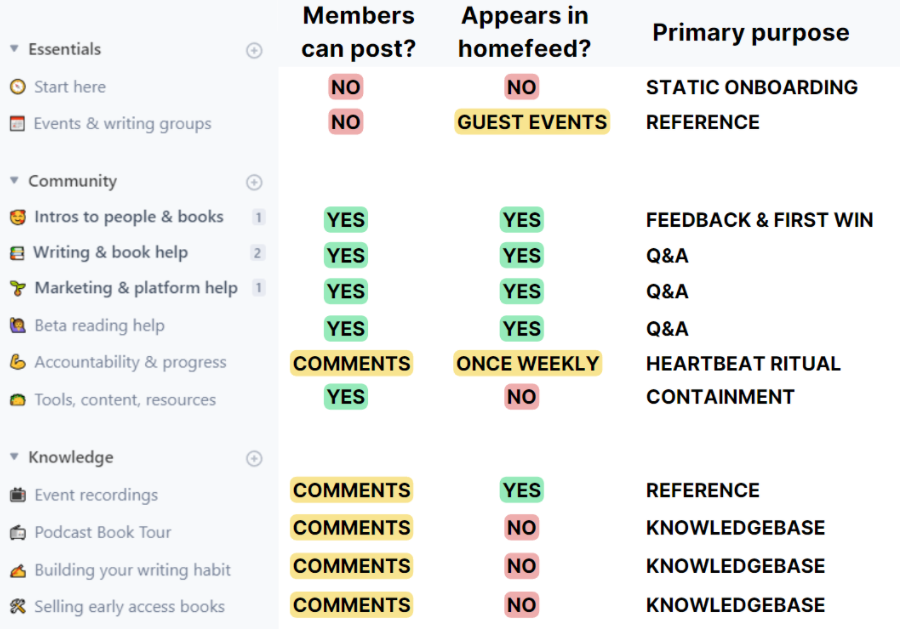
Note the variety of settings and purposes.
In theory, the knowledgebases will prevent common questions from being repeatedly asked.
The tools & content space is pure containment, since although some people love quick link posts, many don’t. So this provides a place for those links (include the occasional self-promotional or off-topic link) without burdening the home feed.
. . .
I’ve got a working theory that, unless defended, every successful community eventually becomes overtaken by marketers who want to sell shit to the other members.
But they’ll only make the effort if they think they’re getting meaningful exposure. So by controlling the visibility (in the homefeed, notifications, adn email) of that sort of content, I believe that you can make the overall community an undesirable target for self-promoters.
Comments (6)
i like what Skrob says in RP about aspirational steps.
So regarding this
> every action that your members want to take
I might experiment with every aspirational step your members want to take along the onramp/progress path using Skrob language. That way it will also reinforce the progress path
Oo, I love that idea. Once you start thinking about the implementation, share some sketches/ideas/outlines of how that would look — I'd love to see an example.
Actually Rob, I have been thinking about progress path in my context of autonomy-first SaaS builders since the first day you turned me to Kathy Sierra and R. Skrob.
It's very hard because the temptation is very strong to be very prescriptive with the progress path.
To have purely "aspirational steps" per Skrob's definition and also per Sierra's definition keep the path be a "steady stream of progressively powerful capabilities and benefits"
On the other hand, i hypothesize this might be the 80-20 principle at work (or at least that's how i console myself) that if i crack this, the progress path will define most of the OOC.
Right now, all i have is a few candidate ideas for possible steps in no particular order:
1. make 1k in gross profit as a business with 3 dimensions for modifiers: software/not software; services/product; recurring/not recurring
2. pay down technical debt using <insert name for technique -- maybe Close the Loop/Zeigarnik Effect> technique
3. achieve founder-market-product fit quantitatively (using Casey Winter's definition at Casey’s Guide to Finding Product/Market Fit | Casey Accidental)
4. ??
I must say writing the 3 steps down initially feels very confronting because I have been (over) thinking abt them for a couple weeks already.
I’m glad you asked 👍
> My biggest frustration with [most community homes] is that they feel like a giant room full of filing cabinets, or a hall of windowless doors.
ooooh, this af with e.g. Discord
super helpful posts, bookmarking for a closer read & reflect. i def have too many spaces 😂
Now that I have published , I should compare my current spaces against this. Makes me want to have a “meta” space in my own community