Flywheels and virtuous cycles (community activity → curation & commentary → content marketing)
The most important influences on your OOC design are: 1 // What your members require in order to succeed 2 // What you can handle operationally (calendar, timing, etc.)
But one another factor (which often remains hidden until later) is: 3 // What your business requires in order to grow
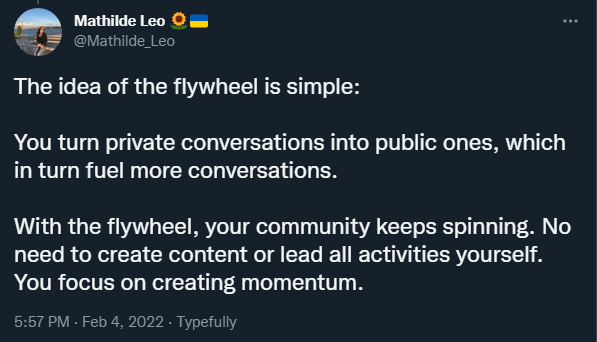
For growth, the strongest option is loosely referred to as a “content flywheel”:
(mathilde’s thread)
Examples:
- Community Q&A/education events can be recorded, edited, and shared publicly as an podcast and video interview, and also as clips (i.e., everything is doing with Exploded Media)
- Interesting community discussions get collected and curated into permanent knowledgebase pieces that can be released as long-form articles
- When you notice a common or interesting issue/question/challenge, you can reply with a public piece of content like a video reply or article (i.e., treating the community’s questions as a content prompt for yourself)
- All of the above can also be rearranged as a email drip campaign, as Dru Rly does with the trends.vc newsletter, reusing the weekly industry deep-dive done for paying members (50k free email subscribers → 1k paid community members)
- In certain industries, member discussion/action/beliefs can be collected into a “statement about the industry from the X community” and used as a guest posting or resyndication piece
- Any of the above can be repurposed into a lead magnet, ebook, or big content piece
The idea is to ensure that a subset of your activities are doing double duty, working “live” for the private group and then also “afterwards” as public marketing.
(In my walkthrough, I called this “Virtuous loops of content marketing” (in the right-most column), but I’ll likely start using the more common “flywheel” label instead.)
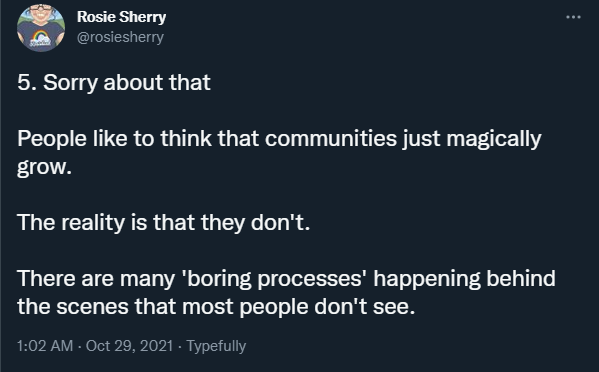
Which creates a nice, repeatable, “boring process” for growth:
(rosie’s thread)
Of course, this must be done with respect toward the privacy and primacy of member conversations/progress — part of the magic of the communities is in their ability to create a “safe space” where members feel willing to talk about weakness.
I don’t think you’d be able to (or want to) repurpose all community content into a public flywheel. But it’s probably worth ensuring that you’re community activities are kicking off at least something that you can put out there.
Comments (2)
This is great!
I was exactly considering this last week, as I get questions from my students: and I made my first "public" video (for my students), here.
But I'm going to keep this in mind, and continue to make these for my students and when I have things set up I'll start posting some on YT!
“" part of the magic of the communities is in their ability to create a "safe space" where members feel willing to talk about weakness."”
I think it can be very empowering for the person if one phrases it like it's a common problem, right? As in, "I'm making this video because I got a question that I've gotten often before."
“"The idea is to ensure that a subset of your activities are doing double duty, working "live" for the private group and then also "afterwords" as public marketing."”
This. I've just copied this into a note on my computer.
I agree: it's a lot of dry work (wouldn't say boring, but definitely very dry) involved in building the framework and processes for all of this!
“"I don't think you'd be able to (or want to) repurpose all community content into a public flywheel."”
Now, how do you know what to share and what not to share? and in public, is it better to share a
1. rough video, or a
2. fully polished thing?
ie. is it a benefit to not have things perfect?
That's useful, thanks!
Lenny Rachitsky's community has a volunteer that compiles a weekly "Community Wisdom" post which is then shared with subscribers (see screenshot). But making at least a part of this content it public makes a lot of sense.[image.png]