Member context worksheet v0.1 (walkthrough & example)
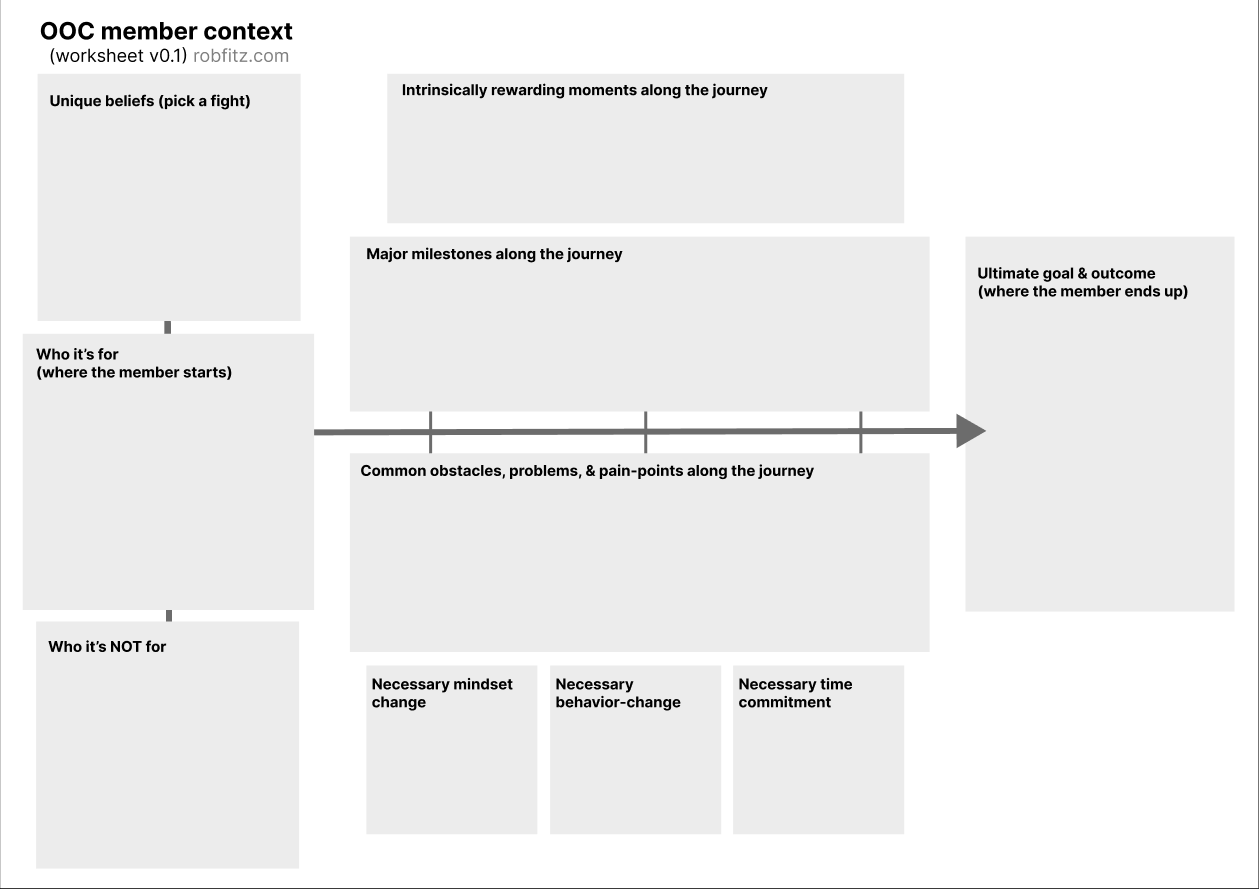
To help us all nail down our member context (i.e., the foundational step before designing the system itself), I put together a little worksheet (with more to come for the remaining design tasks). If you want to give it a try, I’ll leave as much feedback as I am capable of!
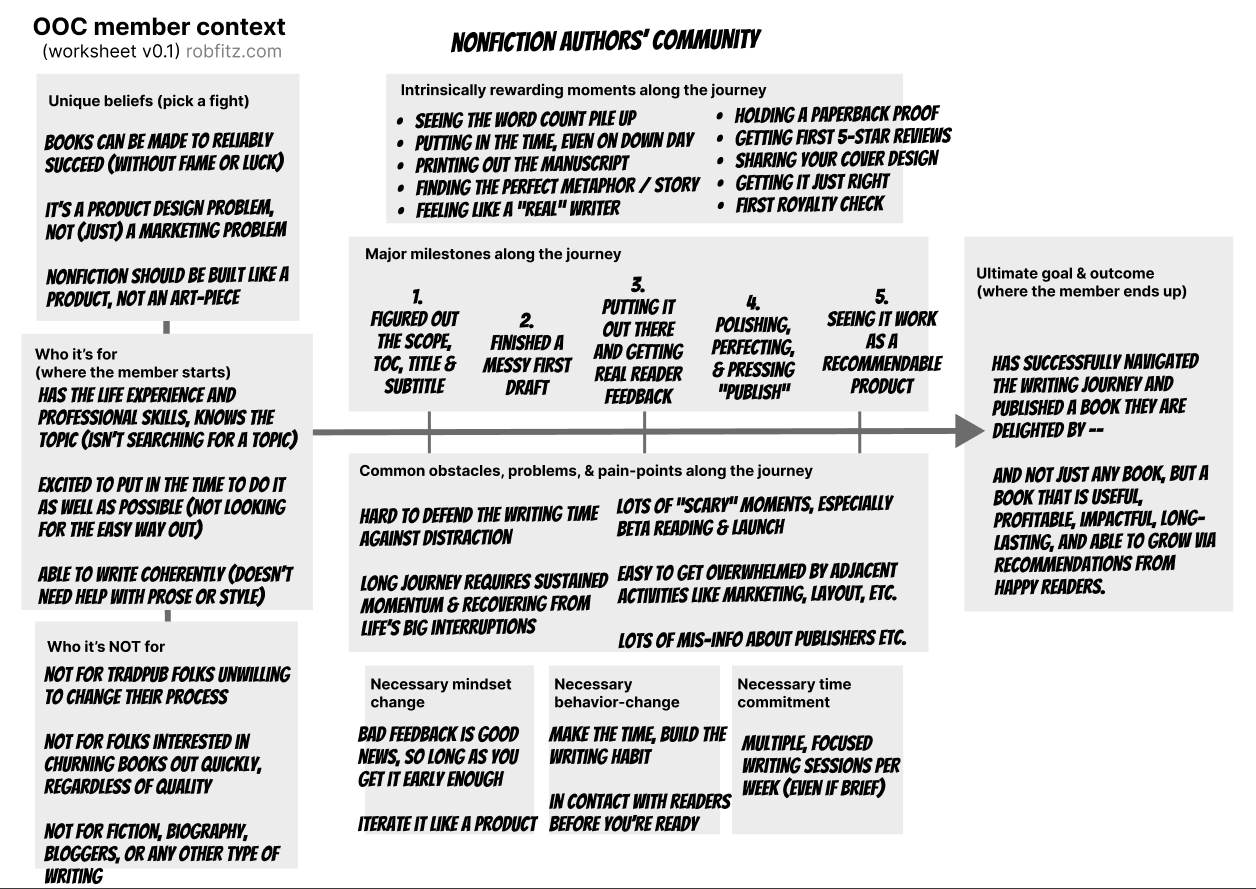
This is an extremely early version, without any in-built explainers or guidance, so I recorded a brief video to walk through how it works, as well as a worked example. (The worksheet and example images are also pasted below.)
Blank worksheet:
Worked example:
Hit me up with any suggestions/confusion/requests/ideas.
Excited to see if it unlocks anything for you :)
Comments (18)
The journey motif reminds me of a talk by Jared Spool on "Things users want to know" https://www.uxmatters.com/mt/archives/2006/07/experiencing-chi-2006-from-a-practitioners-viewpoint-part-ii.php
Questions related to understanding needs and solutions:
Identifying needs
Understanding identified needs
Isolating alternatives
Choosing solutions
Refining solutions
Questions related to external parties:
Helping others resolve their problems
Educating others about their own issues
Contacting support resources
Purchasing and supporting products
Dealing with institutions
Questions related to news and milestones:
Alleviating fear (inukshuk / personal milestones)
Venting
Learning about topical news
Learning about general news
Here is my first cut welcome any questions, suggestions, or critique. I am sorry but I don't find the "canvas" representation helpful and it's a pain in the ass to edit/maintain. I also think obstacles, mindset change, behavior change, and time commitment should be broken out by stage.
Unique Beliefs (counter culture / strong choice)
• Build your startup using your time, know-how, and revenue from customers
• Ends become means and means become ends - sequential journey involving exploration, iteration
• Relationships and Know-How much more important than Money
• Give to Get
Who's it for (where members start)
• People with unique expertise, experience, or perspectives that allow them to provide differentiated products to poorly understood problems
• People able to start today - willing to "go ugly early" in ways that don't abuse peer or prospect trust.
• People willing to engage in conversation with strangers, listen to alternate perspectives (don't have to agree), and offer their perspective--based on their direct experience--in a respectful and kind manner.
Who it's NOT for
• People looking for a franchise or "treasure map."
• People who only want to help entrepreneurs if they get paid for every transaction / interaction
• People who only want to talk about what they will do once they get funding (e.g. loan, investment, grant).
• People who want to quote from various books of entrepreneurial scripture without the context of personal efforts to apply it.
Intrinsically rewarding moments along the journey
• Feeling heard, voicing your fears and realizing everyone around the table has had to face the same challenges.
• Reaching a common understanding with a prospect on their needs.
• Reaching agreement with a prospect on how your product can help.
• Getting paid by a customer.
• Getting a referral from a customer
• Finding co-conspirators: cofounders, partners. advisors, contractors, employees
Major Milestones (including ultimate goal / outcome)
• (From https://www.skmurphy.com/startup-stages/)
• See also quiz to locate where you are https://app.assessmentgenerator.com/assessment/4354
• Idea and Formation
• Open for Business
• Early Customer
• Finding Your Niche
• Scaling up
Common Obstacles, problems, pain points
• Belief that investment money is plentiful and open to anyone with an idea (may be mindset change)
• Leaving a carer path to deal with the crippling uncertainty of finding your niche.
• Nothing new ever works, cultivating the patience to iterate with intelligent variation / tinkering
• Able to mange work/work balance: keep working/freelancing/consulting to "keep the lights on" as you develop, market, and sell your new product or service.
Necessary mindset change (probably should be broken out by stage)
• Quid Pro Quo: Commit to delivering value to your customers to get paid.
• Take Responsibility for outcomes
Necessary behavior change (stop doing / start doing) again should probably be broken out by stage.
• Get up early or otherwise make time in your day and week to work on your startup.
• Build a support network / kitchen cabinet / peer advisory group that is distinct from what you have done to get hired and advance your career.
• Help other entrepreneurs and ask them for help.
• Take action when you are 70% certain.
• Spend less money - save more.
• spend time with family and friends to maintain a personal support network: remember that life is what happens while you are making other plans.
Necessary time commitment
• For bootstrapper breakfast - a few hours a month.
• For startup at least 10-15 hours a week as you hold down gainful employment.
On that live accountability shared call, do people talk to each other or share there screen? I'm having a hard time understanding what that event is like for your book writing community.
"Happy OOCing!" ... love that sign off. ❤️
Yes, it's a 1 hour live session, where the first 15 minutes is each of us stating our past week's book-related progress and our current priority, then 30 minutes of silent co-working on the top priority, and then a 15 minute wrap up to review how it went and plan our goals for the coming week. To see how we describe it to members, check out: https://lu.ma/writing-group (although don't actually register, since that one is just for the Authors OOC members :P)
Oh, and in case it's relevant, I didn't invent the Writing Accountability Group format that we're using there -- once I knew what we were trying to do, I just searched around for tested formats, and I borrowed verbatim the one from Johns Hopkins that they use to help folks make steady progress on their dissertations: https://www.hopkinsmedicine.org/fac_development/career-path/wags.html
Thanks for this!
I saw your video on YT and loved it, I just came off the Circle webinar and your video just amplified my growing energy!
I’m going to fill this in, awesome stuff
Just a quick placeholder note that this is seen (and appreciated!), but I likely won't be able to reply properly until Monday (away from the desk for the next few days to celebrate my mom's 70th)
I took a shot at filling this out. I'll share it, though I explicitly do not need feedback as I'm not really happy with it as a good draft (yet), but I thought Rob might benefit from seeing something.
I agree with a previous observation that editing windows of text in my image editor was not very convenient, and I likely will not return to the format.
I like the idea of experimenting with layouts and visuals, this just was more trouble than it was worth.[ooc-sheet.png]
This is a good start. What will members learn along the way or as a result of completing the project? Is the end point the launch of an open source project or a product people will pay for?
This great - I will have a go at filling it in on Monday. Weirdly I had already visualised some of the system this week. [The path (2).pdf]One additional component was adding a "Give back" section with the idea that those have achieved the desired status can help others along their journey in a paid for coaching capacity.
My video recording setup seems to have somehow fully stopped working, but hopefully text will do the trick. Your milestones and goal seem fairly bulletproof, so I'll focus on the margins ;)
1 // I think you've got some potential upside available in sharpening your positioning / unique beliefs. As written, they feel positioned against the default beliefs of VC/hypergrowth startups, and I wonder what it might look like if positioned instead against the default beliefs of folks who already self-identify as bootstrappers.
For example, you could "pick a fight" with a characterized version of the IndieHackers worldview, which could be something like, "it's about generosity, not growth hacking." (I.E., your give-to-get & long-term values.)
Or you could "pick a fight" with the "bootstrapping=lifestyle" crowd by anchoring on either the bias toward action referenced in several of your points ("bootstrapping is work, and it's worth it") or by anchoring on the constrained idea selection and daisy-chaining of resources ("to increase your chances, constrain your idea selection," "you can't do everything, at least not yet").
One thread that connects some of the values/beliefs/etc., is the idea of finding a way to begin making real progress without waiting for the permission of any sort of authority figure or gatekeeper, and by working with the assets/resources/constraints that you've already got on hand.
I can actually imagine doubling down on that belief as the community's single and primary unique value, by flipping it into something more aspirational via, "you don't need anybody's permission," or more rebellious via, "stop giving the power to gatekeepers you never needed in the first place."
(All of the above attempts at pithy brainworms are just off-the-cuff first takes -- I'm sure you could find alternatives that are stronger and more compelling aligned with your values and comms -- not trying to push you toward vacuous clickbaity stuff.)
2 // I really like the set of intrinsically rewarding moments you've pulled together, and I can imagine some of them being activated through a bit of design/priming on either the introduction or the heartbeat. For example, voicing fears and feeling heard could be easily tied into either the introduction and/or a monthly/quarterly heartbeat event or ritual.
(I did a bit of secret shopping in another authors' community, and they had an occasional networking event where one of the chitchat prompts was, "what's the piece of writing that you have been procrastinating on the longest, and why is it giving you such a hard time?" Which led to some pretty wonderful conversation, actually.)
And stuff like having a killer conversation (whether discovery, validation, or sales) is something that can be easily amplified as a member success story or shoutout or "lessons learned" or whatever else.
3 // A few of the other bits and pieces, I can imagine being reinforced over time as demonstrated values, as opposed to being an explicit part of the "rules" or "pitch."
For example, when someone gives generously of their time & feedback and really makes a difference to someone in the community, I can imagine you (or someone from your team) chiming in to the thread and reinforcing it by saying something about how it's the exact same sort of give-first approach that works wonders when you're getting started with the early customers.
Or if someone chimes in with a business book quote, you can give a little quick response nudge along the lines of, "always best to keep these things grounded in experience, and it sounds like this idea strikes a chord with you -- was there a time when you were able to put it into practice? or wish that you had?" (and optionally share a story of your own experience to soften the blow, although that obviously has a higher time cost.) This publically demonstrates the "desired" behavior/value without expecting folks to remember a list of rules and without throwing anybody under the bus.
We do this ~10-20% of the time after introductions in the authors community, where someone comes in with guns blazing, trying to impress everybody with how awesome they are (or the opposite, of being far too sheepish and not giving any information for anybody to respond to). Instead of either leaving things quiet (ineffective) or referring them to the theoretical rulebook (hostile and ineffective), we just set them up for success by asking a helpful follow-up question. And once they respond to that guidance, everyone else finds it easier to jump in and add further conversation/support/advice/etc.
Alright, that's all I've got -- hope it's not an entirely useless wall of text :P
It's helpful and strongly preferred to a video. You may not have captured all of the ideas that would have occurred to you in a stream of conscious video but you are more coherent and comprehensible in writing.
I am settling less on an OOC model and more on a Community of Practice model but this advice is still helpful. I want create an improvement community around a key set of shared values that are distinct from the promises of many others -- but not all others. I want to be part of a leadership team of peers who help to protect the community from vandals, predators, vampires, but profit from my membership in the community not necessarily run it as a business. Run it as a service to the community and be clear about demark between SKMurphy, Inc. and Bootstrapper Breakfast (r). It will have a brand promise and a break-even model.
I position against the VC perspective because it's background radiation in Silicon Valley and I am still SV-centric at least in my thinking. In other parts of the country, and the world for that matter, what SV calls "bootstrapping" is referred to as "Starting a business."
IH seems obsessed with Product Hunt, complemented by a number of self-appointed gurus spamming the community on an all too regular basis. it's interesting that HN is moderated--and benefits from dang--where IH does not seem to be. It's functionally astroturf for Stripe https://www.indiehackers.com/blog/acquired-by-stripe
Seth Godin talks a lot about "pick yourself" which I find to be a more useful variant of the "permission-less innovation." The latter seems to be VC positioning for anti-social / anti-community actions by portfolio firms.
You have added some good points worth incorporating
• pick yourself
• appeal to existing bootstrappers
I am OK with "lifestyle business" member in community as long as they commit to ongoing learning and self-improvement, as well as providing value to their customers. I guess I am really allergic to
• the "four hour work week" crowd, aka "make money while you sleep." https://www.skmurphy.com/blog/2014/07/30/michael-ellsberg-four-reasons-why-passive-income-is-a-destructive-fantasy/
• Don't care what others think--at least in ways that lead you to act like an unkind greedy jackass. You have to live with being an outlier, but that's no excuse for acting in a way that is untrustworthy or does not provide "quid pro quo" value https://www.skmurphy.com/blog/2015/04/16/innovation-the-trick-is-managing-the-pain/
https://www.skmurphy.com/blog/2015/11/10/the-unreasonable-entrepreneur/
• the "growth hacking" crowd when it engages in deception or trickery for short term gain (Lean Startup embraces aspects of this with landing pages that collect emails but don't provide value and registration or payment links that don't work, as well as menu items that say "not implemented"
• work your competition into the ground https://www.skmurphy.com/blog/2012/07/20/working-day-and-night//working-day-and-night/
https://www.skmurphy.com/blog/2015/03/05/if-you-are-cycling-through-chaos-keep-pedaling/
• solopreneur fantasy when it verges on autarky. You give up too much progress for total control https://www.skmurphy.com/blog/2008/11/28/offer-scope-for-employees-to-exercise-their-vital-powers/
Thanks for your feedback, definitely thought provoking and helped me to clarify what I am in favor of and against. It's also clear I need to invite other practitioners / service providers of many stripes (e.g. attorneys, accountants, CTO-to-go, sales and marketing folks) and explain the "ground rules" on demark between helpful and "hard sell."
One of the thing that I really liked about the Lean Startup Circle google group--alas new emails are now disabled by Eric's crack support crew--was that anyone could put real problems on the table and get a variety of perspectives. I should comb through those archives and contact the top 50 or so contributors.
I guess I am energized by real problems--and real opportunities it's not clear how to explore--posed by the entrepreneurs trying to manage them.
Sounds like you're well on track, so the below is more random riffs than an actual response.
The golden age of IH was strongly moderated/guided by Rosie Sherry, and IH's "fall" began, at least IMO, immediately upon her departure. She was doing a lot behind the scenes to demonstrate the culture, including everything from nudging individual comments/threads in a productive direction and inviting successful IHers to do AMAs/interviews/events. Part of my "read" of their later failure is that they had over-relied on the efforts of a single, extremely capable "superhero," such that they had never bothered to build the system. So once the superhero left, everything quickly became overtaken by the most motivated agents, which, in the case of IH, was "growth hackers."
(Which is kind of sad for IH, but great for picking a fight with it, since the best "opponent" is one that everybody else is already annoyed by, but who is still sitting in the #1 seat. Which, for bootstrapping, is IH.)
Before dang, HN was moderated directly (for quite a few years), by PG. I remember talking to him at a barbeque ~2009 about some of the experiments he was doing with HN to reduce trolling and nudge toward more productive discussion (including several experiments that had backfired dramatically). He was the person who invented (in the most literal sense possible) the original email spam detection that's still the grandfather of everything we use today, so he had a pretty good sense of the brute force way to do it. But he was really interested in figuring out the cultural/implicit/incentive-based way to accomplish the same goal, and he put a lot of deep work into it.
I agree w/ you about the "true" lifestyle goal (because what is entrepreneurship about, if not building the life you want for yourself and your loved ones and the customers you want to impact?). But as you suggest, it's a fairly "poisoned" term, and you could, if you wanted, very easily position against any of the angles you mentioned, without ever feeling as if you were punching down.
PS. I'd be quite interested, if you're ever in the mood, to hear your take on the diff between OOC and Community of Practice. In the stuff I've read about CoP, it's more focused on all members being within a single, large, existing organization, which allows them to make a set of strong assumptions about culture/intention/goals/etc., as a baseline for productive collaboration. So I found a some of the things they focused on to be either irrelevant or impractical for my goals w/ a collection of non-connected authors. But it's also true that I didn't go especially deep into that world, and I may have made too hasty of a decision.
One thing I don't see in your outline are moderation policies and techniques. It's interesting that we both agree that effective moderation provides an important value add to HN over IH and IH regressed when they lost their "hero" and failed to build systems. What was heroic must become routine (true for many aspects of any startup (community)).
Dang has been notable for being much more open about guidelines and process. He clearly has a team of volunteer firemen (vandal hunters) backing him up.
I started "going deep" into the community of practice model in the late 1990's when I was helping start "best practice" groups at Cisco for hardware design: ASIC, PCB, Mechanical, Signal Integrity, and perhaps a few more. Cisco at that point had acquired 70 companies and was trying to bring a number of different engineering teams into a set of coherent practices as well as try to standard methods and libraries so design and building blocks (sub-assemblies, modules) could be shared across business units. My discovery after the second or third meeting was that a presentation on "our best practice' was quickly tuned out, but a group presenting "here is a problem we could use you help and perspective on" unlock a tremendous amount of useful perspectives and actionable insights. Something I carried forward into the Bootstrapper Breakfast.
A second key learning was that there was a "change constant" or "Zone of proximal development" for any group: they could only move so far in a given period of time. So you needed to build salmon ladders that allowed people and teams to gradually integrate new practices and methods (perhaps later to abandon, refine, evolve them as they became capable of moving on).
I had been involved with the Design Automation Conference since 1982 and realized that it constituted a community of practice at an industry level. You are correct that corporations cultivate CoPs for the same reasons that beekeepers tend to hives, to accrue benefit. But that is not the only model. It's been well studied because companies pay consultants a lot of money to help them instigate and grow CoPs but it's not the only model.
The "invisible college" of the Scientific Revolution was initially mediated by letters and scientific journals. The contributors / members were all independent amateurs, some with patrons, a few government funded, many independently wealthy.
The craft apprentice systems: novice/apprentice, journeyman, master essentially viewed each workshop and each town guild as a CoP. Key indicators: hierarchy of knowledge, many contributing at their level helping the less advanced, legitimate peripheral participation (novices can listen, watch demonstrations by journeyman or masters and still learn), respect and manage zone of proximal development, error budgets for experimentation and learning, key performance metrics at a higher level (e..g. Birmingham had a contest for the most efficient steam engine every year with knowledge and recipes shared).
Sorry I am well down the rabbit hole now but there is quite a bit to CoP that relates to learning theory, adult learning models (andragogy), knowledge acquisition and curation models, tacit and team level knowledge vs. explicit knowledge, and incentive mechanisms for progress.
One last thought, knowledge acquisition and integration for use is a long process, see https://www.skmurphy.com/blog/2012/06/17/marcelo-rinesi-the-expertise-light-speed-barrier/ Expertise constitutes a significant barrier to entry, perhaps second only to trusted relationships. Anything you can do to reduce the friction related to knowledge acquisition and knitting a web of trusted relationships offers enormous advantage.
I suspect different people will have different end goals (some looking to build legit paid-for products, others just using the project as a journey to scratch a personal itch or skill up on a specific tech).
I suspect the common outcome is better project management skills and opportunites to learn from others doing Elixir on real-world applications.
I think that end point matters a lot in terms of the return on time/effort and money/fees. It's how a prospective community member will decide if the time and fee structure provide enough value -- where will this take me? It also tells you who you are competing with. If it's project management training and Elixir training that's very different from launching a product.
Very good points. Thanks for sharing.