On growing community without becoming the bottleneck // How hands-off, how soon?
The recent post and comment from got me thinking, especially this bit:
One really impressive thing about AltMBA is that the course is not delivered by Godin himself. He has found a crew that runs the show without him.
That is magical. […] Designing such a course and finding such a crew is a dream for me, perhaps for most OOC builders.
Becoming an essential (the essential?) ingredient is one of the more interesting failure-modes for a community, since it looks very much like success, right up until you need to take time off for that vacation/sabbatical/emergency and find that you can’t.
On the one hand, every community must grow through the early “content and concierge” stage; obsessing over avoiding absolutely any reliance on yourself at this stage feels like a case of premature scale. (And a shortcut to presiding over a very hands-off ghost town.)
But on the other hand, you do want to feel that the community is trending toward being increasingly self-sufficient.
(With the authors group, at least, these isn’t because I want to stop doing it, but rather to ensure that I’ve got the time and attention to work on systems-level stuff, and because I want the work to feel sustainable enough that I can keep doing it.)
Anyway, I’m not sure that there’s a single guiding principle in my tinkering thus far, so maybe the best I can do is share a few examples. These seem tactical and minor, but taken together, they’ve been transformational to my calendar and freedom.
Weekly community newsletter
Here I’m following the model from Buzzing Communities📕 of treating the newsletter like a local newspaper (i.e., summarize what’s happening in your area) as opposed to a national newspaper (i.e., original research and reporting). Beyond being easier and more repeatable, it’s also far more delegatable.
As such, each week’s structure is exactly the same: upcoming events, community discussions, member progress, and some other similar little bits and pieces.
To get to the repeatable format, I did the first couple newsletters myself, created the style guide and process, and then took a step back into a support role, providing feedback to someone else who was drafting it. For each newsletter, I’d record a video with commentary about tone, language, style, contents, structure, etc. The first video of that sort was over 45 minutes long, with loads of suggested changes, large and small. After a couple weeks, the team was nailing it, and I didn’t even have any suggestions.
Maintaining enough discussion
Early on, I mainly relied on Alex Hillman’s suggestion to “be the party starter, not the star” by responding to questions without actually answering them, but by instead tagging in another member who I knew would know the answer.
(Just be careful not to exhaust any particular members by tagging them in too often. Another danger is to take this sort of inventionism too far, leading to the pursuit of vanity engagement. As long as people are making progress, seeing progress, and getting help when they need it, you’ve probably got enough discussion happening.)
The authors’ group is now at the stage where conversation (usually) happens without us needing to prompt it. Regardless, we do maintain an emergency backlog of potential content that can be posted by anyone on the team to fill things out in a pinch. When any of us stumbles across an interesting quote, tool, or resource, we throw it into a Notion page for this purpose.
Speaking of the team, we’re currently five in total, although only myself and one other are “officially” involved in the community. (The other three are on product and/or ops.) Still, we’ve built the habit that everyone do a deep dive into recent discussions once per week, so we’ve got a mix of “official” people saying hello and being involved rather than only myself.
Checking in on member progress and accountability
We tried several approaches to nudging members into sharing their progress.
First, we tried setting up a “little wins” channel that almost nobody remembered (or wanted) to use.
After that, I tried nudging members individually, which would work approximately once per member. To reduce the friction, I then started following members on Twitter/LinkedIn and giving them shoutouts in the group when they announced progress elsewhere. (The latter approach might work for a different community niche, but progress was too hard to stop in ours, so we dropped it.)
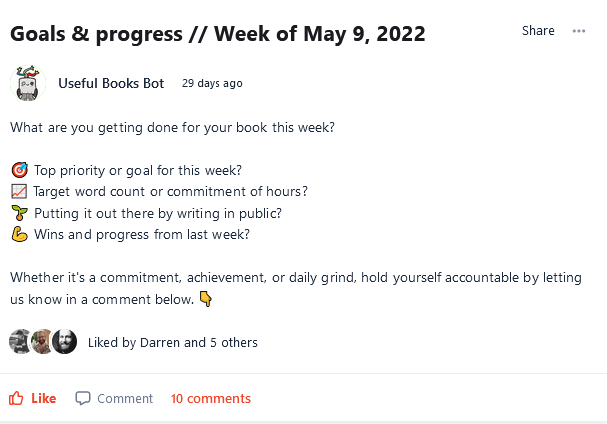
These days, we rely on an automated, weekly post in a special channel via our “Useful Books Bot.” That post is scheduled such that it can be linked in each week’s newsletter, and people seem to feel more comfortable responding as a comment rather than initiating a fresh post. And I really appreciate that the post is made by the robot instead of by me.
Lots of options exist here. I know of other communities that solve the checkin problem via occasional automated DMs (leading into a brief survey or videoask). And others that have this delegated to a human support team.
Regular, recurring events
We run 4 weekly writing accountability groups. 3 of the 4 are now facilitated by other people (two by a professional, one by a volunteer). I still try to show up to them every so often as a participant, but I usually don’t need to.
To get it delegatable, we started with just one or two per week, which I ran myself in order to figure out the details. Once it was solid, I wrote a one-page facilitation guide, and then started finding people to host while I attended to supervise and provide post-event feedback. Then it was all theirs.
Our next step here should be allowing many more community volunteers to step up and run sessions, and I’m exploring the tooling to make this a little bit more reliable. (And I’m hoping that the new member knowledge sharing events will help identify potential session leaders.)
Halo effect and “being seen”
I’m truthfully not sure how to completely solve this one, but I think that once you’re at scale, small doses of face time can go a long way.
E.G., GaryVee’s company runs the costly 4Ds courses/cohorts almost entirely without him, and he just shows up for some rapid fire Q&A at one point during each cohort. I don’t want to dig through fifty hours of his videos to find the quote, but he draws the same line when dealing with his agency’s consulting clients (paraphrased): “Do they want me? Of course. Do they get me? No.”
It’s probably possible to get away with not showing up at all (as it sounds like Godin does with AltMBA), but I’d have to think that there’s a high cost in doing so too early. It’s very possible I’m wrong on this one, but going 100% hands-off feels a little bit like a luxury addition once you’re already succeeding quite hard.
Anyway, that’s what I’ve done
Lots more to figure out, of course, but maybe my experiences muddling through some of the above will give you some useful ideas.
The authors’ community is now at the point where I can step away for a couple weeks at a time, if needed, which is great. (Although I need to call in a couple small favors to do so, since a thing or two still need an eye kept on them.)
I still work on it pretty actively as my top priority, so it’s not like the overall workload has decreased. But most of that time is going into longer-term improvements, not just treading water, which feels substantially more optimistic.
So that’s me, I guess. Am I missing a trick? Misreading the situation? What were the big inflection points – or simply the difficult situations – in your groups thus far?
Comments (8)
i am at a different growth stage as i am still early early in the "content-and-concierge"
"content and concierge" -- Fantastic label, Rob, btw. I will be using that as my keywords and that post as my canonical definition.
Most of the tactics you shared above require some small amount of activity and audience already. What if you're at zero or near-zero members like I am?
So I'm thinking of finding public story / question like you did with that sad HN story of 12 years a founder story. And then assume it's a AMA and answer it in the public space of the community software.
Then your tactic of the weekly newsletter will kinda work by including such QnA content
What do you think?
That makes total sense to me. Back when I was getting started with youtube Q&A videos, nobody knew that they could ask me stuff, so I would just grab random tweets or IndieHacker posts and "reply" to them with a video. Another guiding principle is to using the concierge and content stage to prioritize the evergreen content that you're going to want to use in your onboarding or knowledgebase. That way it's serving double duty as concierged content + long-term asset.
thank you. That makes sense to me.
You know talking with you and fellow members having this back and forth
I can almost see your OOC book write itself.
I’m impressed by this non-forcing process. Feels very organic
“I can almost see your OOC book write itself.”
One can dream ;). But ya, this is basically the same process I normally do for my books via reader conversations, beta reading, and followups, but a bit more scalable and in public. Thus far, I'm finding it both enjoyable and effective.
About reader conversations and helpthisbook.com ... I found the idea brilliant. Getting feedback before you publish a book is a slam dunk that we should all be doing. In fact, for posts too. Good idea to build software for it. Then I realized there are ways to get there already: Medium has highlights where the audience comments on what you write. David Kadavy (an useful writer) recommends it here: https://kadavy.net/blog/posts/how-to-write-a-book/ . It was in front of me all this time, but I never valued that feature of Medium. I disliked medium because it was a platform and I'm very much against bigTech and platforms nowadays.
Then I saw another solution: gdocs in public mode! Look at this: https://docs.google.com/document/d/1I-zp_u2xpsm5EWplgL886F7pNmX_5M-uTn1IczsDcz8/edit#
One more thing to look at is lesswrong. It's kinda a forum where anyone can write long form, and comments are not mostly a waste of time like in most blogs/yotube videos. That is, commenters help the main post author refine his ideas.
> responding to questions without actually answering them, but by instead tagging in another member who I knew would know the answer
ooh good one, i could be doing this a bit more without exhausting anyone's good will
I used GDocs for my 2nd book (workshop survival guide) and it works well enough -- a totally fine option that I still recommend in some cases. Two nitpicks with using GDocs are that the "blank" comment field tends to encourage "safe" suggestions like typos, while discouraging negative and big picture feedback like "slow", "confusing", etc. In our early testing, we've seen about 10x more comments per reader, and 20x more of the right kind of comments (big picture, negative, etc.). For stuff like Medium, the problem is basically just positioning -- if people think they're reading a finished post, they tend to consumer rather than contribute, although that's potentially solveable with the right framing and positioning.
It's especially powerful (and non-fatiguing) when either (1) the connection is aspirational, i.e., it's someone who is exciting to be connected to, or (2) it's gently promotional for the answerer, e.g., they happen to be a freelancer or building an audience in that space.