Reframing "moderation" as "signal vs. noise"
The word “moderation” is quite adversarial: right vs. wrong. That’s fine for the edge cases of actual hostility, but those are, in my experience, quite rare. The more common obstacle are member contributions that are, for whatever reason, simply more noise than signal.
(“Noise” doesn’t necessarily mean “bad,” just low value to other members within the context of the community. For example, sharing an article about hitting a business milestone is probably noise; whereas sharing the challenges and learnings along the way might be signal.)
I prefer thinking of moderation in terms of “maintaining signal vs. noise” (as opposed to “enforcing right vs. wrong”), since it can then be addressed via design rather than decree, and in advance rather than after the fact.
Ex 1: Signal vs. noise to strengthen new member intros
Consider a new member intro that says:
Hi everyone, I’m working on a book about getting started in management – excited to be here and learn from you all! :D
The above introduction is polite and friendly. It’s also noise. Why? Because it’s non-valuable to other members. This introduction sets up a double-edged disappointment: the new member won’t receive any meaningful feedback or support (since they didn’t expose any surface area to allow for it), so they’ll perceive their whole intro as a speedbump (i.e., an action that fails to deliver a meaningful reward); and there’s nothing for other members to learn from or contribute to, which makes it noise for everyone else as well.
This is a common, critical situation poorly served by the “moderation” frame of mind. This new member hasn’t done anything “wrong” that you might be able to “moderate” or “correct.” But their contribution is clearly low-value, despite their best intentions. And if you repeat this pattern enough time, the whole community suffers: existing members stop reading intros, new members stop giving intros, and you’ve built yourself a polite ghost town.
So, to use our framing of maintaining signal vs. noise, how can we improve this type of empty intro?
1 // The first tool is scaffolding (where “scaffolding” is some amount of supportive structure/guidance/constraints around an open-ended task to make “success” easier).
Here’s the scaffolding for intros in Useful Authors:
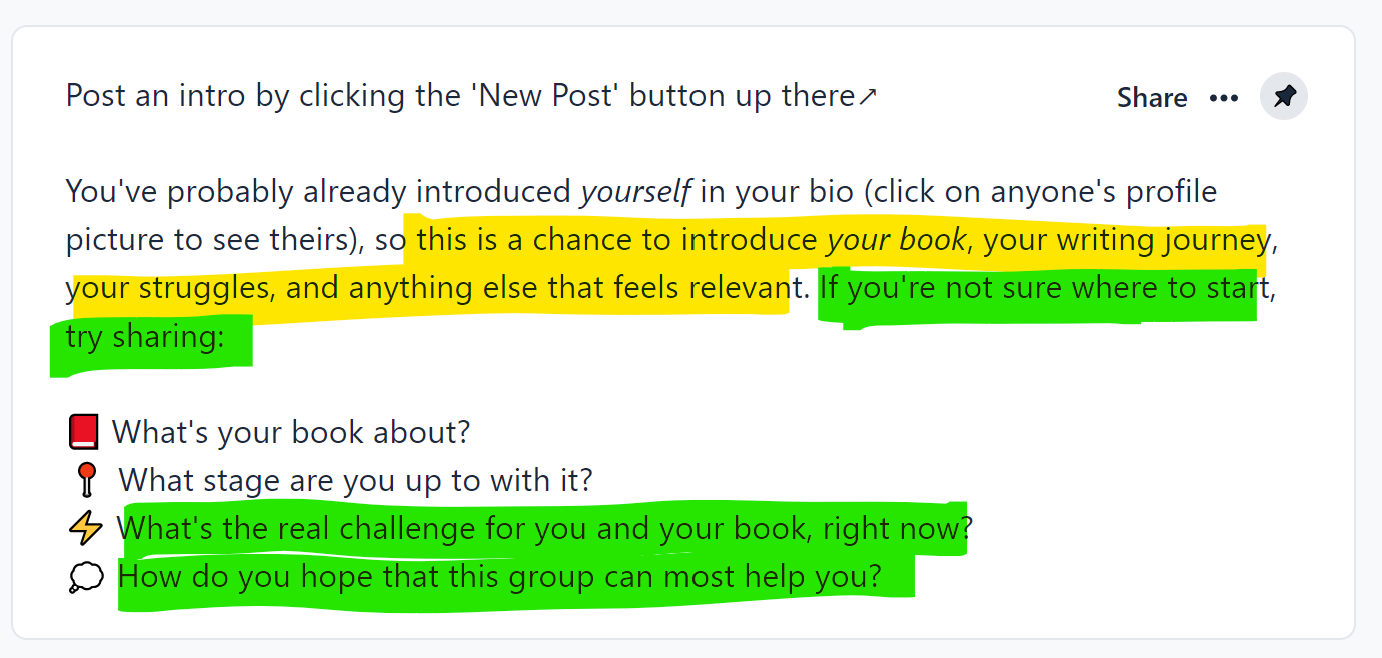
~Half of new members will use this structure verbatim (often even including the emojis), and the other half will go off script, but with a sense of where they’re trying to arrive.
2 // A second tool, for this situation, is the alley-oop (a basketball thing where you aren’t try to hit the basket yourself, but only loft the ball up such that one of your teammates can more easily get it in there). I.E., Your maneuver is about setting up someone else’s success.
For example, let’s say you see the polite-but-empty intro from above. Instead of either ignoring it or giving a generic reply (“Welcome to the group, great to have you here!”), you can reply with an alley-oop to set them up to succeed:
Welcome! Mind sharing where you’re up to in the process and what’s currently got you stressed or holding you back with it? Easier for us to be helpful if we know what you’re working through ;)
This is serving the same role as the scaffolding, but reactively insetad of in advance.
Another type of “noisy” intro is the “everything is great” introduction, where they’re stuck in “impressive CV mode” and are demonstrating only strength, not weakness, which makes it tough for anyone else to productively engage.
In this situation, a strong alley-oop response can be something like:
Nice to have an author in the group who has got it all figured out ;)
This playfully invites the new member to share some of their challenges and concerns, without explicitly criticizing their original introduction. And almost always, they’ll quickly respond with something like:
Oh no no no, I certainly don’t have it all figured out, that’s why I’m here. In fact, I’m really struggling with X…
At which point, the thread is no longer noise, since there’s something for other members to engage with. (As an aside: this particular alley-oop comes from Andrew Warner’s excellent book about hosting interviews: Stop Asking Questions📕%F0%9F%93%95).)
Ex 2: “Niche” posts that are “signal” to some, “noise” to most
The “signal vs. noise” metaphor runs deeper than just introductions.
For example, in Useful Authors, we started seeing a number of authors posting to ask for direct, detailed feedback on some part of their book. While that might be a core interaction in other groups, in the Authors’ group it isn’t, and the vast majority of our members see these requests as more “noise” than “signal.” But I can’t “moderate” these posts away, since that would feel far too harsh.
My solution was to create a “release valve” for this behavior by creating a new space for it that is set to be opt-in rather than automatically joined:
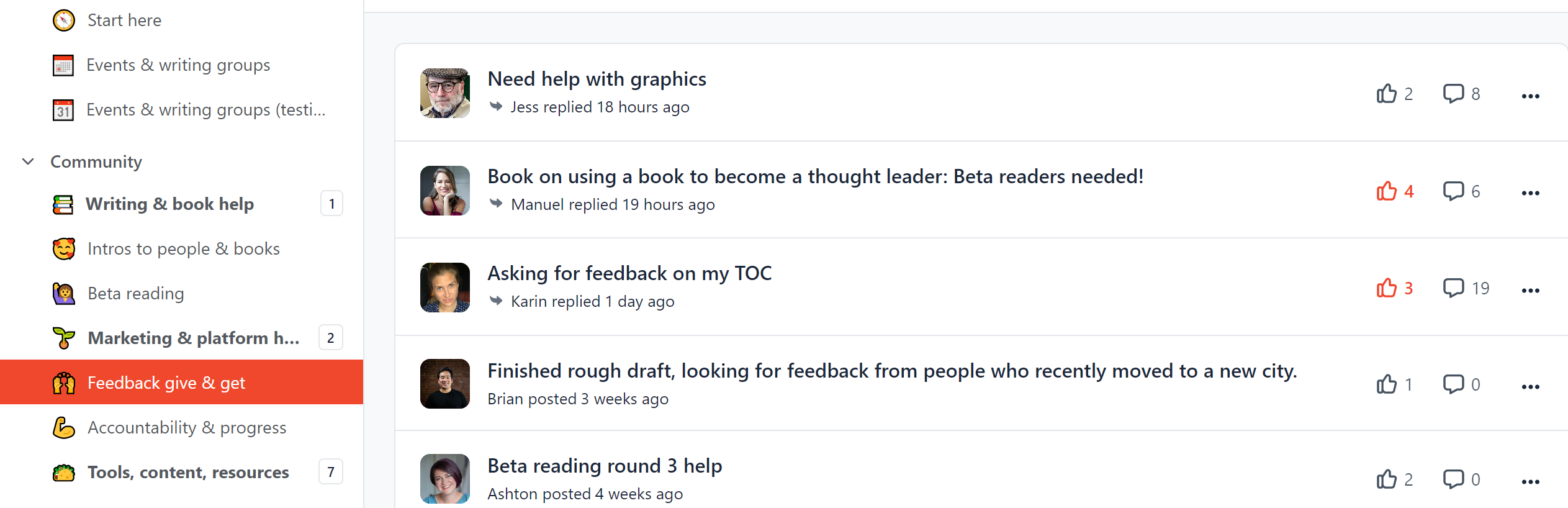
~12% of members have chosen to join this space (i.e., they’ve self identifying as finding value in the feedback requests) and will see these posts on their home feed. The other ~88% have chosen not to, which removes that source of noise for the “default” member.
One incentives challenge was that, at first, nobody wanted to use the Feedback space for the simple reason that it was empty and quiet – a miniature ghost town!
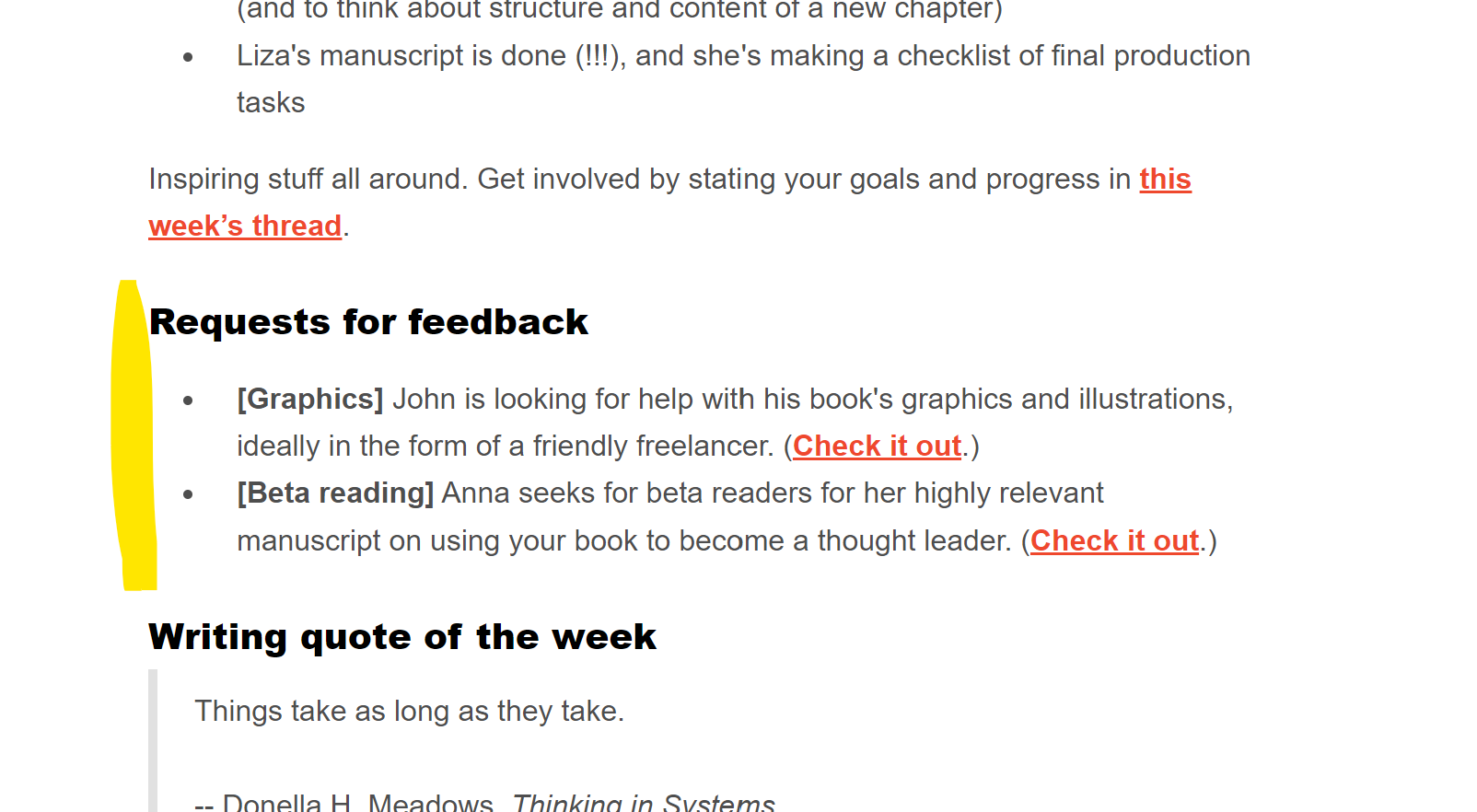
To help address this, I went through a bunch of historical posts in the main spaces and moved them into the feedback space, so it would appear more active. I also added an amplifier into the newsletter heartbeat (less “noisy” to have it there than on the homefeed), demonstrating that requests for feedback are being seen and heard:
These are only a few of many possible examples (signal vs. noise can also be applied to self-promotion, mundane and repetitive questions, and more).
Of course, if something actively hostile or hurtful appears, you do need to moderate it immediately. Moderation is emergency surgery: use it when necessary, but don’t treat it as your only tool, nor as your first line of defense. First, attempt to improve the scaffolding, design, or incentives to either vent, disincentivize, or improve the behavior in question.
As a guiding principle, why not give it a try?
Stop thinking “moderation” and start thinking “improving the signal vs. noise.”
It helps simplify a whole bunch of community design decisions.
Comments (5)
For scaling and systematizing, creating templates for that kind of alley-oop for moderators/peer mentors/whatever-member-role (or even yourself) to use is also helpful as you begin to recognize the patterns of where that kind of reaction tends to be needed even after adjusting design, incentives, scaffolding, etc.
At one point I was in a paid feedback role for a group course, and no matter how certain assignments were structured, there was always a proportion of folks who would have a lot of "noise" to their contributions -- which meant their peers didn't engage and couldn't give good feedback, as in your intros example. Those of us paid to intervene developed a playbook to quickly move people out of the noise and into signal that others could respond to. Made things much faster.
And, for that matter, we had similar playbooks for intervening in less-than-helpful feedback from members, notably non-constructive feedback, unsolicited feedback, and feedback-from-outside-their-actual-degree-of-expertise.
The "opt-in" space is a really helpful idea for me to think about, thanks for that. I feel certain it will come in handy, though I can't actually think of where it'll be needed yet.
Unrelated note, I'm curious how you template or otherwise ease the workflow with your heartbeat newsletter...
I think you are on to something with this. I think there are a couple of tensions around moderation / curation:
• high emotional content vs. primarily factual content -- I think providing emotional support on the journey and allowing for a certain amount of venting frustration may seem like tolerating noise but is a helpful support.
• sharing a real problem (asking a real problem) vs. self-promotion -- again a certain amount of self-promotion allows you to understand the person's view of their strengths. But a little goes a long way. I think if a person shares a real problem asks a real question you should set a timer or an expectation of a "report back." Here is what I did and here is what happened. This creates more of a shared learning.
• posting a question in a category vs. adding tags later vs. curation into a FAQ. There comes a point when a FAQ can save everyone time - newcomers and old-timers. Here asking a question answered in the FAQ should at least acknowledge having read the FAQ (or searched it) and some comment on why it was not applicable or otherwise satisfactory.
• facts / tips vs. introduction / connection: A complementary alternative to a FAQ might be either a SIG or introductions to others in the group who have faced the challenge. I think connection is as valuable as information, provided that a useful conversation ensues--and even better--a connection is made. "moderator" as "connector" or "tummler." Malcolm Gladwell's "Six Degrees of Lois Weisberg" offers a good profile https://web.archive.org/web/20131018075644/http://gladwell.com/six-degrees-of-lois-weisberg/
• primary norms vs. opt-in subcultures - this is my framing of your story of authors requesting detailed critique. It's interesting I run a small non-fiction mastermind where we all do is either read a passage aloud, or present an aspect of a promotion plan and then get feedback. I found this more useful--your mileage may vary--than the "famous authors" guest lectures that seemed to be the emerging primary norm in the useful books group.
• show your homework vs. a blooming buzzing confusion It's good when you can propose a well structured scaffolding (as you outline in your scaffolding for authors) but at the breakfast meetings it can be a help to someone just to be listened to by the group for a few minutes as they explain their "blooming buzzing confusion" about their business. Obviously the group needs to move to some structured problem solving approach the next step is often asking clarifying questions about goal, context, constraints, and efforts/accomplishments to date. See https://www.skmurphy.com/blog/2015/09/25/asking-questions-from-a-caring-perspective/ for a description of the Quaker model for a Clearness Committee (some guidelines are at https://web.archive.org/web/20100326075745/http://atlanta.quaker.org/Clearness_Committees_and_Their_Use_in_Personal_Discernment.pdf)
Some of my key take-aways for the Bootstrapper Breakfast
• Because so much of our interaction is synchronous (zoom or face to face) there are probably other aspects of signal vs. noise we need to uncover. We have maintained a facilitation guide for moderators, I need to consider how to apply some of those rules to discord.
• We have made several efforts to publish a FAQ (the Bootstrappers Breakfast Cookbook) but have not been able to make it happen. This may be a systems / tooling issue or a lack of clarity on what's needed.
• More scaffolding would probably help our members, certainly for Discord introductions. We probably need some more explicit suggestions / guidelines for some of the service providers that show up.
• A different category of "self-promotion" is entrepreneurs asking to demo their app (web / mobile) which we don't allow. Many groups make the demo the core of an entrepreneur meeting. We don't. I think the challenge is to differentiate between an entrepreneur's natural enthusiasm for a product and the beginning of a direct sales pitch.
This take-away Stop thinking "moderation" and start thinking "improving the signal vs. noise." was extremely helpful.
The moderation snippets are something we've briefly spoken about having for the authors group, and you've convinced me that I need to go ahead and get that done -- thanks.
For the authors' email heartbeat, we have a ConvertKit template where the basic structure is:
1. Events & news (usually just 1-2 bullets)
2. Discussions (usually 2-5 posts, where we give a journalistic summary of the post + discussion)
3. Member progress & wins (gathered from the accountability thread and writing groups, usually 10-30 bullets starting with people's names)
4. Requests for feedback (usually 0-4 per week, but this may increase over time, since it's a newer behavior)
5. [Only if relevant] New "official" content like an author interview video
6. Writing quote of the week (we dump new quotes into a notion page as we find them, and then just grab one each week and mark it as "used")
Alongside the Convertkit template, we've got a fairly robust style guide with examples of subtle right/wrong distinctions of tense/wording/tone, and a big checklist for putting it together (via Notion card templates).
Under "normal" circumstances, one of our team does the content and another does the ConvertKit, and they work together to proof each other's work for typos and blunders. But we've currently got 40% of the team on maternity leave (soon to be 60-80%), so I'm doing it myself at the moment.
I wrote a couple other posts about our email heartbeat:
• For my general feelings/worldview about the whole thing, check why the OOC is on an auto-email whereas the authors' group is bespoke
• For a little video walkthrough (3m) of the format/template/design itself: /c/ooc-design/rethinking-my-email-heartbeat
• And to support stubbing the email content itself, I made a simple heartbeat helper (but truthfully I don't always use it, since it's not that much faster, in its current state, than just doing it manually)
The tensions raised are very interesting since, as you've mentioned, what might be "noise" for one group (e.g., emotional venting/support) could be very much "signal" for another. I feel like it somehow loops back toward the member context and some thoughtful reflection on which types of interactions will be meaningful (or mundane) for the particular type of people you've planted a flag for and brought together.
What I about to say is definitely noise in the context of OOC and this thread but given that i am in both Useful Authors and here:
With regards to feedback for writing,
1. I found this model of giving feedback How to Give Great Feedback (iswong.com) via a newsletter course/community to be super useful both as feedback giver and writer
With regards about noise and signal, let me give some specific examples
1. the founders of that community repeatedly show how they gave feedback live in the webinar sessions and afterwards still give feedback for followup efforts by the members.
2. Granted, it's easier for them to do so when the group is small (like less than 10 but all 10 chose a weekly newsletter cadence)
3. Over time, the early members start to reciprocate by doing it amongst themselves.
4. But the founders are still doing it albeit without covering everyone all the time.
5. the members know about 4 whenever they go to give feedback on fellow members drafts and come across earlier feedback left by the founders. So this leaves an impression.
Taking the above specific examples i can broadly summarize as the following parenting advice cliche
1. Role Model the Behavior You Want to See From Your Kids (verywellfamily.com) Role model the behavior you want to see
2. How to Praise Your Children: The Right and Wrong Way To Do It (parents.com) Catch 'em doing good and praise them
I would argue psychologically any adult learning new things is akin to being a small child.
Take with a pinch of salt because I never started a community successfully, not a parent, but joined plenty of communities and courses and CBC as member.
Bad behavior (or noise) also drives out the good members in a way similar to Gresham's law - Wikipedia