Better users // less content // Badass by Kathy Sierra
📕BADASS: Making Users Awesome by Kathy Sierra 📘Retention Point by Robert Skrob
Have you ever felt that a book was written just for you, for this precise moment in your journey, magically anticipating every question you might have?
This week, Kathy Sierra’s 📕BADASS made me feel that way.
Don’t make a better camera, make a better photographer. — Kathy Sierra
If somebody buys your camera and doesn’t end up taking pictures they’re proud of, they won’t recommend the camera.
Your recommendation loop is less about the product’s features, and more about your user’s ability to get results with them.
I self-workshopped the hell out of this book — every page has notes and ideas.
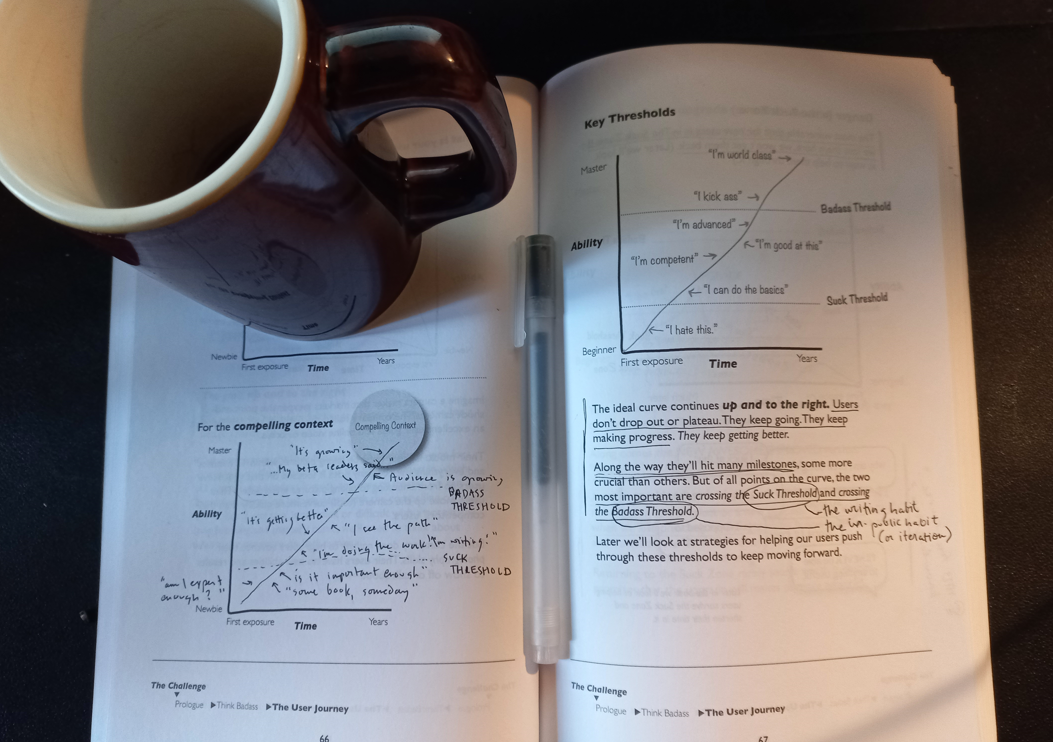
Also, users who are more “badass” (i.e., users who get it, can do it, and are improving) are able to discern subtle differences in the tools and task, making them open to power features, upgrades, and add-ons.
Badass users are:
- more valuable on their own
- and are a recommendation engines for others.
Making folks badass doesn’t mean adding more features. It means supporting them through their journey via education, inspiration, communication, and habit change. (Sound familiar?)
📕BADASS feels like a more complete and canonical attempt at the same set of ideas that Robert Skrob was getting at in 📘Retention Point (which I also loved, but I’d only recommend it to community builders rather than to everyone).
I was glad for the overlap, since having both perspectives helped several important ideas to click, like why offering too much educational content can backfire:
For some reason Membership Marketers turn into teachers as soon as a customer buys their product.
Suddenly they deliver curriculums, steps to do, places to visit and, worse, books to read. They outline the 27 steps to accomplish the outcome that was promised in the promo.
This is just as bad as giving your members too little guidance. *It all boils down to the difference between a teacher and a leader.* — Robert Skrob, Retention Point
I read that and believed it, but I didn’t fully understand it.
Isn’t more of a good thing a good thing?
Kathy clicked it for me:
The best way to deal with the brain’s spam filter is to reduce the amount of things that need to get past it.
Making content easier for their brain to pay attention to is good. Making less content is much better.
Does that knowledge really need to be in the manual? Do they really need to read the knowledge base [or] whole book? Or participate in that webinar?
Brains prefer Just-in-Time learning over Just-in-Case learning. Just-in-Time means learning something only when/because you actually need to use it. But Just-in-Case is the predominant model for most forms of education (and most user manuals). To the brain, Just-in-Case can seem useless. — Kathy Sierra, BADASS (lightly edited for lengthy)
📕BADASS is an absolute must-read for anyone who builds stuff.
(Plus, the book is delightfully weird, and I found myself laughing out loud on several occasions while imagining the publisher’s reactions to Kathy’s insistence that it remain this way.)
Comments (9)
Heard a lot abt the book 📕 but never bothered to look it up. Watched two YouTube videos done by Sierra and I’m impressed by the content
Now getting the book from a local library
You won't regret it ;)
on my way to collect the book 📕🙌
> You won't regret it ;)
you're right. I have decided to go buy the actual book
'Badass' users sounds like what the Category Pirates call 'superusers', it's well worth checking out their material too. I find it really helps to have the same things said in different ways.
Love this:
"Brains prefer Just-in-Time learning over Just-in-Case learning. Just-in-Time means learning something only when/because you actually need to use it. But Just-in-Case is the predominant model for most forms of education (and most user manuals). To the brain, Just-in-Case can seem useless.
— Kathy Sierra, BADASS (lightly edited for lengthy) "
I'm reading "the design of everyday things" at the moment, and the difference between 'knowledge in the head' and 'knowledge in the world' seems relevant here.
If there is enough 'knowledge in the world' (or 'in the product'), people can stick to 'Just-in-time' learning AND have room for interpretation.
Beautiful comparison -- 100%. E.g., if you need to spend a ton of time explaining how the community's spaces are set up, then you're wasting precious onboarding time/attention/goodwill. Much better to make the organization self-evident (or the discovery unnecessary) in some way.
sorry, not superusers, superconsumers.
i'm thinking of "power users" same idea, diff label :)