On ideas that people can remember and use // Craft and words
The Elements of Eloquence📗, by Mark Forsyth, is one of my comfort books.
I crack it open when I’m feeling a bit cynical about it all and find myself drawn back to solid footing by the book’s joyful celebration of craft and craftspeople:
Shakespeare was not a genius. He was, without the distant shadow of a doubt, the most wonderful writer who ever breathed. But not a genius. No angels handed him his lines, no fairies proofread for him. Instead, he learnt techniques, he learnt tricks, and he learnt them well.
Shakespeare got better and better and better, which was easy because he started badly, like most people starting a new job.
Do not, dear reader, worry if you have not read [Shakespeare’s early plays]. Almost nobody has, because, to be utterly frank, they’re not very good. To be precise about it, there isn’t a single memorable line in any of them.
I very much enjoy the playful unmasking of the rhetorical “tricks” behind famously memorable bits of sayings and songs:
Any phrase, so long as it alliterates, is memorable and will be believed even if it’s a bunch of nonsense. Curiosity, for example, did not kill the cat. […] In fact, the original proverb […] was ‘*care* killed the cat.’ And even that one was changed. When the proverb was first recorded (in Shakespeare, actually, although he seems to be just referring to a well known bit of folk wisdom), *care* meant sorrow or unhappiness. But by the twentieth century it was care in the sense of too much kindness. […] In a hundred years’ time it may be something else that does the pussy-killing, although you can be certain that whatever it is – kindness, consternation or corruption – will begin with a C or K.
As well as Forsyth’s pervasive meta-lesson that there is deep, satisfying craft to be found in wordsmithing, despite our teachers’ best attempts to ruin it for us:
English teaching at school is, unfortunately, obsessed with what a poet thought, as though that were of any interest to anyone. Rather than being taught about how a poem is phrased, schoolchildren are asked to write essays on what William Blake thought about the Tiger; despite the fact that William Blake was a nutjob whose opinions, in a civilised society, would be of no interest to anybody apart from his parole officer. A poet is not somebody who has great thoughts. That is the menial duty of the philosopher. A poet is somebody who expresses his thoughts, however commonplace they may be, exquisitely.
I’ve meanwhile been reading Dan & Chip Heath’s exceptional Made to Stick📕, which attacks the same question of sentence-craft from the perspective of not just memorability, but also teachability and actionability:
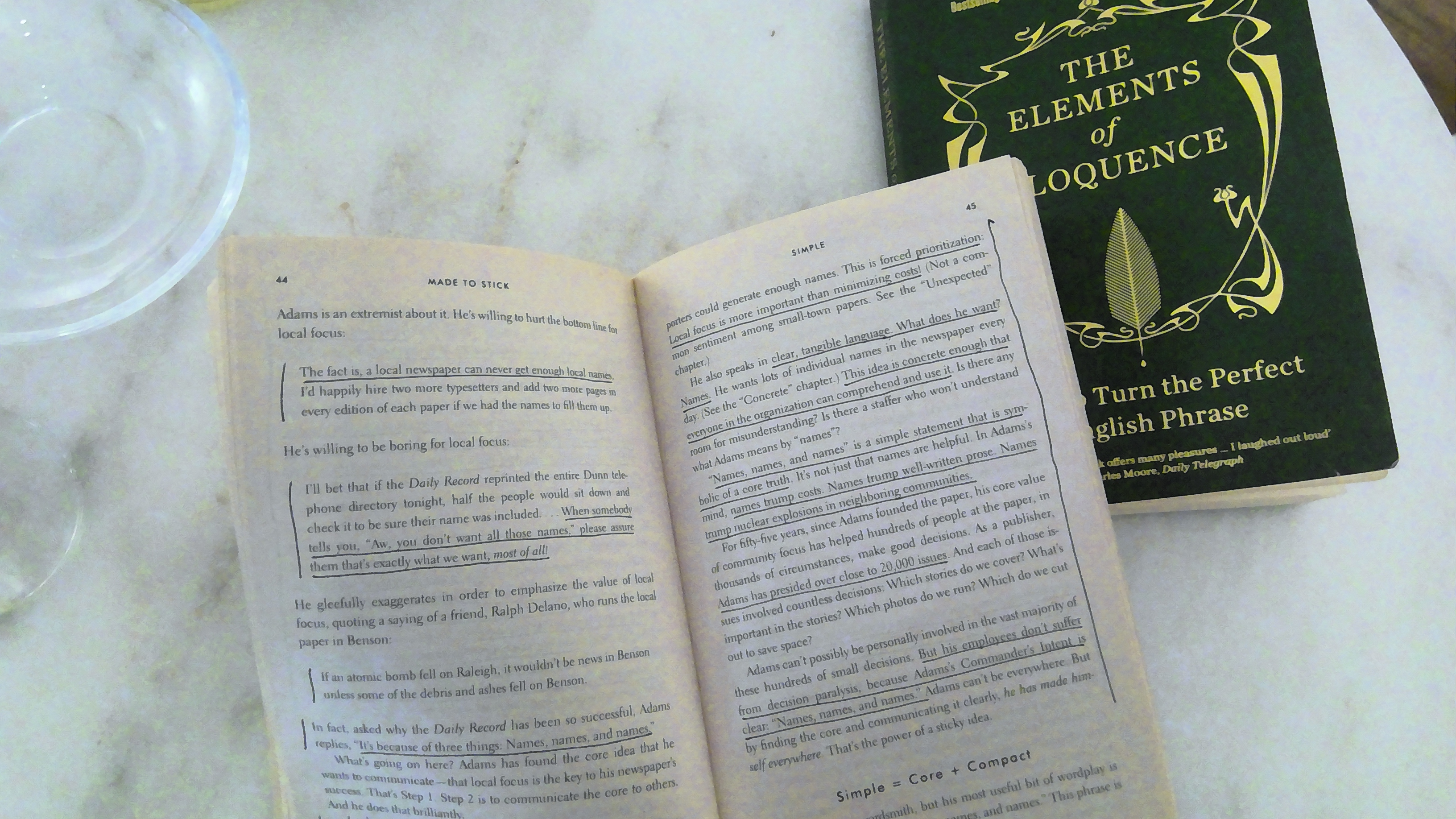
Reflecting on a remarkable lesson from a teacher of journalism (just one class period!), the Heaths remark:
This [lesson design] should be in the Sticky Hall of Fame. This teacher had a huge impact not because he was a dynamic speaker or a caring mentor–though he may have been both–but because he crafted a brilliant idea. It was an idea that, in a matter of seconds, rewrote the schema of journalism in the minds of his students. An idea that changed a student’s career plans and stuck with [that student] thirty years later.
“But because he crafted a brilliant idea.” I love that so much. With care and craft, ideas can be made to work better! A single, well-crafted idea can change a whole life! And many more lives beyond that!
Certain teachers like to claim that “learning happens outside the classroom.” But if you invert that, they’re also claiming that “learning can’t happen inside the classroom.” And with a worldview like that, no fucking wonder! Learning self-evidently can (and should) happen in both places. This strikes a similar note to the equally wrong (and equally pervasive) worldview among publishers, authors, and pundits that “you can’t make money from a book.” Or that books can only succeed if you are either lucky or famous.
Most lessons don’t work because most lessons are badly designed. Same deal with books. (I’m not saying the creators didn’t care, only that they cared about the wrong stuff and ended up creating a “product” that didn’t work for whoever it was supposed to serve.) To draw the conclusion that this is a limitation of the context rather than a failure of the craftsperson is among the most unbelievably self-deluding things I’ve ever heard.
Beyond the damage to our learners, these can’t-help-it beliefs also limit us as craftspeople. Why bother working to improve if you believe it’s all a crap-shoot? I find it profoundly exciting to find, in these two books, so many of the things I don’t yet know about the craft of communication, the tricks I’ve never learned, the tools I’ve overlooked.
From The Elements of Eloquence📗, again:
Genius, as we talk about it today, is some sort of mysterious and combustible substance that burns brightly and burns out. It’s the strange gift of poets and pop stars that allows them to produce one wonderful work in their early twenties and then nothing. It is mysterious. It is there. It is gone.
This is, if you think about it, a rather odd idea. Nobody would talk about a doctor or an accountant or a taxi driver who burnt out too fast. Too brilliant to live long. Pretty much everyone in every profession outside of professional athletics gets better as they go along, for the rather obvious reason that they learn and they practice. Why should writers be different?
Why should anything be different? We can all (and always) learn to do better.
Comments (2)
Made to Stick is one of the core books we teach in our coaching.
I think of the idea itself and explaining the idea as two separate beasts.
First, you have to clarify your idea in simple terms without jargon.
Then, you need to bring it to life, which is where the sticky principles come in.
You can craft a brilliant idea, but without compelling (and sticky) stories, proverbs, and analogies, no one is going to remember it.
I summarized the Made to Stick principles here FWIW: https://ewingschool.com/messaging-principles/
I also love that way of thinking about genius vs hard work. Practice and effort are what make us excellent. People who are "naturals" typically don't learn to practice, so they struggle to improve their baseline. Lots of growth vs fixed mindset (Carol Dweck) at play here as well!
Definitely checking that book out, it's been on my list but never got around to it.
And yes, so true, some of Shakespeares plays are dreadful: I have a personal hatred for Romeo and Juliet, and even those plays that are good, have parts that are really bad and are often cut out of productions.
your comment was really elucidating and bringing together Dweck and the made to stick *chef's kiss*