Strategic reactiveness // Atomic networks and anti-network effects // Bootstrapping community
📘 The Cold Start Problem by Andrew Chen is exceptional. Strongly recommended for anyone building startups or communities.
First, the startling urgency of the early days of building network effects:
*[Uber’s founder] TK grew visibly frustrated [and] paced around the room again.
“No, no! Look guys. Our network is collapsing. We need to stop the bleeding . . . now! Let’s do the other stuff and get it on the road map, but let’s get this email out over the weekend.”
[…] We committed to ship the changes before Monday.*
This sort of “strategic reactiveness” stands in harsh contrast to the conventional startup wisdom of focus, focus. And also the convention wisdom of being proactive, not reactive.
But it makes sense given Chen’s observation that until a network has reached a stable size, it will naturally backslide into a ghost town:
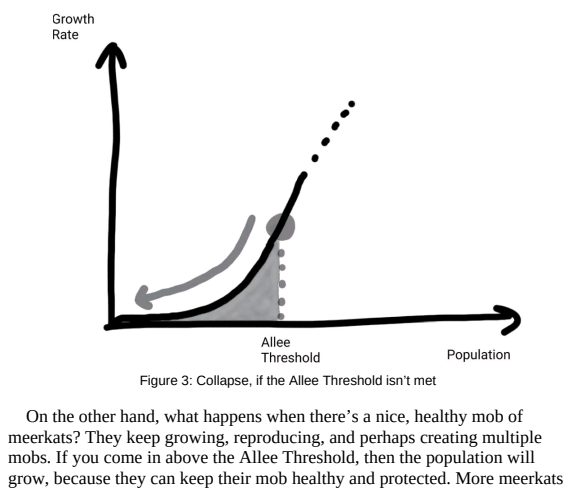
When your primary (and arguably only) goal is to achieve a stable and self-sustaining network, then remaining ready to react immediately to any network disruptions is a rare case where you are being proactive by being reactive.
Chen points out that the strength of your network effect is measurable via the user experience. When most Uber users are able to get a cab within 5 minutes, the network is working. When it takes more than 15 minutes, both riders and drivers become frustrated and the network is at risk of backsliding to zero. (Hence TK’s urgency above.)
If users don’t find who or what they want, they’ll churn. This leads to a self-reinforcing destructive loop.
[…] I call these “anti-network effects.”
In the context of an outcome-oriented community (OOC), although network effects don’t matter for everything, they absolutely do matter for: member introductions/discussions and many events/rituals.
I’d put the backsliding number for discussion at something like getting a good response within 18-24 hours; if it takes much longer than that, you stop coming back. And I’d put the “healthy, stable network” indicator at somewhere like answers in >4 hours (and >5 people at most events).
(Which means that, in the early days, community conversation can be concierged by checking the forum at the start and end of your workday and responding to anything that hasn’t already been convincingly engaged with.)
To grow something stable, Chen suggests thinking of a “network of networks.” For Uber, each city (and sometimes neighborhood) can be stable (or not) independent of the rest of the Uber network. For Slack, a team of just three active users is stable indefinitely, regardless of what’s happening with Slack in other businesses. “Atomic networks,” Chen calls them.
I’ve noticed this with my community’s live Writing Accountability Groups, where the “regulars” at each group have grown into a stronger, tighter, more resilient mini-network within the overall group. (And I think that even if the overall group collapsed, those mini-networks could still survive.)
Two subtle takeaways from the above:
First, as Chen emphasizes, you can grow a network without risk of backsliding by intentionally adding one atomic network at a time. In the case of my authors community, that would mean starting with the writing accountability groups. Under our current setup, people join the overall network and then (hopefully) trickle down into a smaller atomic network within it. Under atom-first model, we would create a new writing group (for example, at a new timezone) and then hustle it hard until it’s reached the point of stability (i.e., >5 attendees each week).
Second, you can reduce your own urgency by picking (or designing) smaller atomic networks. Slack’s atomic networks (of three coworkers) are much less stressful than Uber’s atomic networks (of a neighborhood).
The smaller your atomic network, the easier it will be to build, especially if you’re bootstrapping.
(All quotes are from 📘 The Cold Start Problem by Andrew Chen.)
Comments (4)
“the point of stability (i.e., >5 attendees each week)”
Do you also measure the consecutive periods of the at least 5 attendees each week lasted as part of overall metrics to measure the success of the atomic networks?
We'd like to do something similar — we're currently tracking when people sign up for events (so we can do things like segment and contact the people who have never signed up for a writing group), but we unfortunately don't get another ping when they actually attend (luma doesn't offer it, but tryvirtually apparently does, which is one of the reasons I'm planning to switch to that eventually). I'm not in a huge rush, since I think at our current size, there's going to be pretty substantial variation in the data, so I wouldn't make huge decisions based on it regardless — my claims in the post were more from qualitative observation, and some emergent behaviors like some of the writing groups who have set up their own private mini-channels to chat with each other.
Oh, and the other way I plan to use event attendee data is by giving people little "writing streak badges" next to their username (using Circle's tags) while they're on a run of 4+ writing groups in a row. I think it would be a nice subtle incentive/reminder, but it still needs to be tested.
i can see both good and bad about these streaks and badges.
Sierra in her videos did hint obliquely about her not positive thoughts about gamification. Haha.
Here's a story.
i have been very consistent in updating pioneer.app for almost a year now (50 weeks this week in a row). As you can see here[image.png]They give 50 extra points for each consec week of update, but you cannot score more than 200. And to be perfectly frank, I have been phoning it in for the first 30 weeks or so. It's only in the last 20 weeks, I started to be serious after deep reflection over how I want to prioritize my time each week. Then things start to move. You cannot see the progress made as a third party and these things are not measurable.
But definitely i can sense the shift in momentum after I put my side project as priority 1 for every week.
I'm not against the badges and streaks. But I'm wondering whether it be better to pair the streak-badges with a badge for moving towards a new milestone (in the Skrob sense) every month or quarter. Or capping the changes to the streak-badge.
Here's an example of what i mean by capping changes to the streak badge.
E.g. I get a medal after my first 5 blood donations. Then for the 10th. After that the next medal comes only on the 25th. The next one is 50th. And so on. So each badge gets is tied to a certain number and doesn't change until hitting the next milestone.
Come to think of it, maybe the badge for moving to the next milestone can be a decaying badge. When you hit the next milestone (moving from draft to edit is a new milestone for e.g.) that badge lasts for a period of time, after that it will completely disappear unless you hit yet another new milestone.
Just playing with ideas thinking out loud. NO need to take my comment too seriously