Tony Fadell's BUILD is the handbook for dealing with visionary product risk
Tony Fadell’s BUILD📕 (Tony is the fella who made the iPod and Nest) is exceptional, providing the playbook for startups taking visionary product leaps toward murky, undefined “problems” that live deep in the future (i.e., exactly where Lean Startup style “validation” tends to either get stuck on local maximums, fail entirely, or resort to rhetorical gymnastics to redefine everything into applying).
There’s so much to love in this book, but I especially appreciate the nuance.
Reminiscent of The Hard Thing About Hard Things📘, Fadell offers no easy answers or simple checklists, and yet somehow still manages to provide a clarifying, actionable lens on a huge range of topics.
On data, decisions, and customer learning:
Most people don’t even want to acknowledge that there are opinion-driven decisions or that they have to make them. Because if you follow your gut and your gut is wrong, then there’s nowhere else to cast blame. But if all you did was follow the data and you still failed, then clearly something else was wrong. Someone else screwed up.
This is often a tactic of people who are trying to cover their asses. It’s not my fault! I just went where the data sent me! The data doesn’t lie! That’s why some managers and execs and shareholders demand data even when there is none and then chase that imaginary data directly into the abyss.
At first glance, this is just the pendulum on its natural swing away from data-driven everything. But Fadell is getting at something more nuanced:
If you don’t have enough data to make a decision, you’ll need insights to inform your opinion. Insights can be key learnings about yoru customers or your market or your product space–something substantial that gives you an intuitive feeling for what you should do. […] You won’t reach consensus, but hopefully you’ll be able to form a [informed] gut instinct. Listen to it and take responsibility for what comes next.
Whenever I talk to corporate types about adopting startup-style, qualitative customer learning, we inevitably end up getting stuck on the “rigor” of the data. Cuz managers need a one-pager! I try to push back by saying that if you’re able to summarize “qualitative” data on a pie chart, then that data is worthless, because it’s missing all the important nuance that’s the whole point of the thing.
Fadell puts it more plainly: the point of qualitative, non-scalable customer learning is to build a better gut instinct. * I also love the implication at the end: that you may well get fired over your decision by petty people who need to preserve their own little paychecks. *And that that’s okay, and that being the sort of person who is willing to accept that reputational risk is a necessary (and perhaps even ever-so-slightly heroic?) requirement of building good things that are deep enough in the future that they won’t ever exist unless you make them. (Just ensure that you’ve strengthened your gut instinct first, as far as you are able, with real insight – I’m not, and I don’t think Tony is either, endorsing blind or stupid gambles.)Jumping forward a few chapters, check out this lovely illustration of how narrowly we view the customer journey (i.e., just the bits within the product)…
…vs. how much more expansively and holistically it is experienced by our customers (i.e., every single touchpoint from the first marketing message or content piece, to the purchase confirmation email, to the newsletter spam, to the ineffective customer support, to the incomplete documentation, and so on):
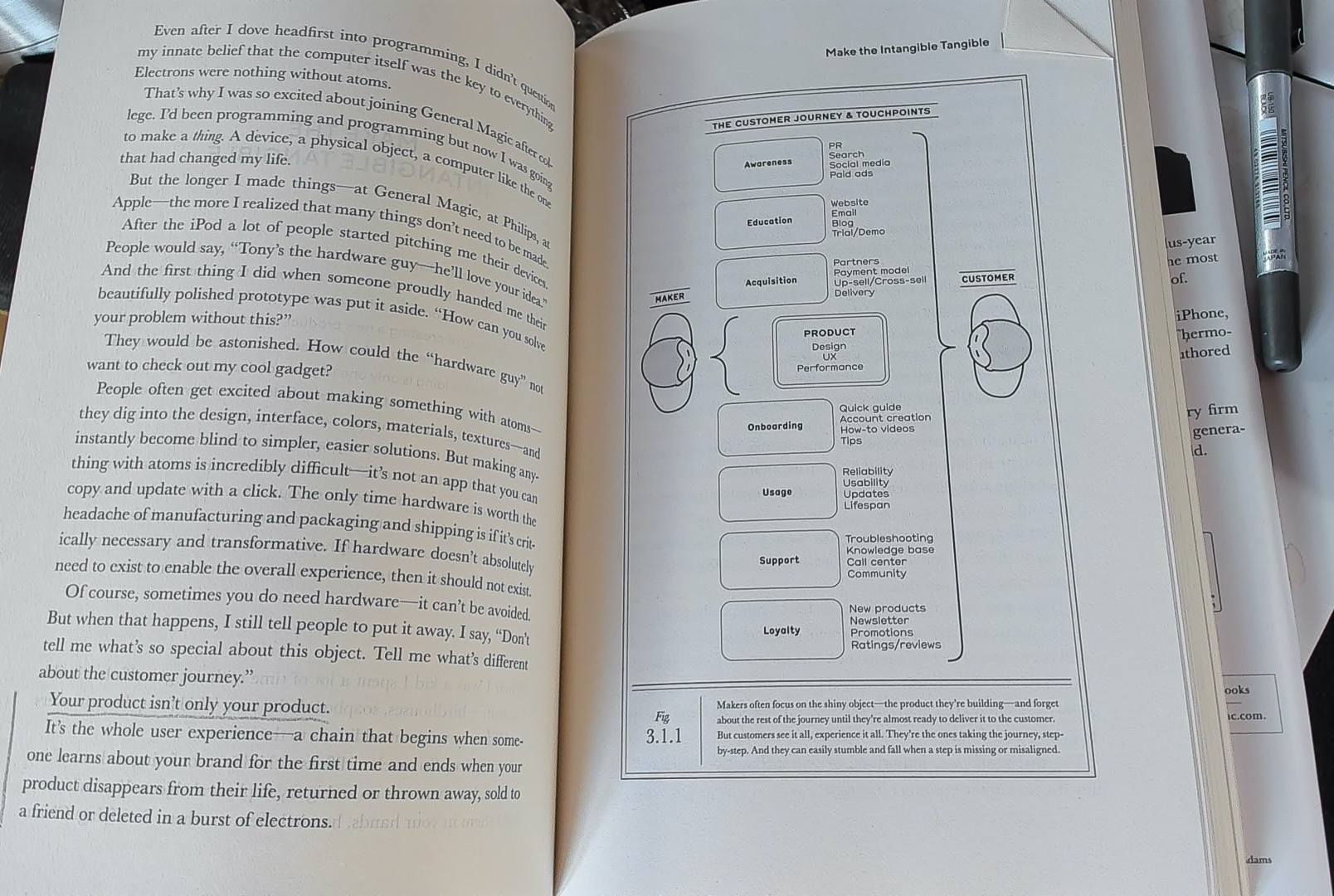
After seeing this, I went through our ENTIRE customer experience, screenshotted EVERY touchpoint, from first encounter onward. I printed them all out, arranged them on the floor (turns out it’s a much longer onramp than I had realized), read through everything in sequence with a red marker in hand, and was duly horrified.Lastly, regarding having to shut something down (or having to quit a gig you loved, that’s no longer right for you):
Once you’re committed to a mission, to an idea – that’s the thing you should stick to. The company is secondary.
Entrepreneurship is a career path, not a company. Do right by the people who have believed in you for this one (employees, investors, customers, partners, etc.), while also remembering that your journey is very likely going to be bigger than one business. Don’t risk knocking yourself out of the game, whether through burning too hard (and burning out) or betting too big (and going bankrupt). Surviving till round two matters more than maximizing round one.
Lots more in the book: BUILD📕, by Tony Fadell. Really, really great read.
Comments (8)
"every single touchpoint from the first marketing message or content piece, to the purchase confirmation email, to the newsletter spam, to the ineffective customer support, to the incomplete documentation, and so on"
Yes. This. Or as my friend Barnaby Wynter used to say "everything is marketing".
Thanks for suggesting Build. Ordered. So stocked you are back to updating your site and sharing entrepreneurship advice!
Also, this OOC is getting expensive! 😂
Hah, I'll never feel bad about convincing folks to buy good books :P. This one isn't OOC-specific in any sort of way, but certainly my top business book from recent years.
Thanks man. A bit of time off, some re-prioritization, and a slower tempo in general seemed to end up being quite restorative for me -- feeling far more bright-eyed and bushy-tailed these days.
and I never feel bad about buying them. It's just that I'll soon need another extension to hold them all!
We all need that at some point. Hope to talk soon and thanks for everything you do.
No way! I read it this spring after it came out!
The photo you took is exactly the diagram I took a picture of, I had it on my list to come to the OOCers and give a book recommendation.
I agree with you on the point that people love data, honestly I think I've been chasing non-data in the last 2 years, but especially these last months. When no data is available, use your gut instinct.
“Entrepreneurship is a career path, not a company. Do right by the people who have believed in you for this one (employees, investors, customers, partners, etc.), while also remembering that your journey is very likely going to be bigger than one business. Don't risk knocking yourself out of the game, whether through burning too hard (and burning out) or betting too big (and going bankrupt). Surviving till round two matters more than maximizing round one.”
This was great to read, really with you there. Is this your next book? 😛 entrepreneurism as a career.
ps. Have you read Hugh McLeod("Ignore everybody" and "Evil plans")? Sort of reminiscent of that.