What would have to be true for this to be a winning choice? // Make more options
📗 Playing to Win by Lafley and Martin (2013)
As I continue attempting to debug my recurring overwhelm, I tried running it through the standard strategy models. Most strategy books have negative value and will actively make you stupider, but a few are priceless.
Playing to Win is a one of the good ones (also Rumelt’s Good Strategy / Bad Strategy):
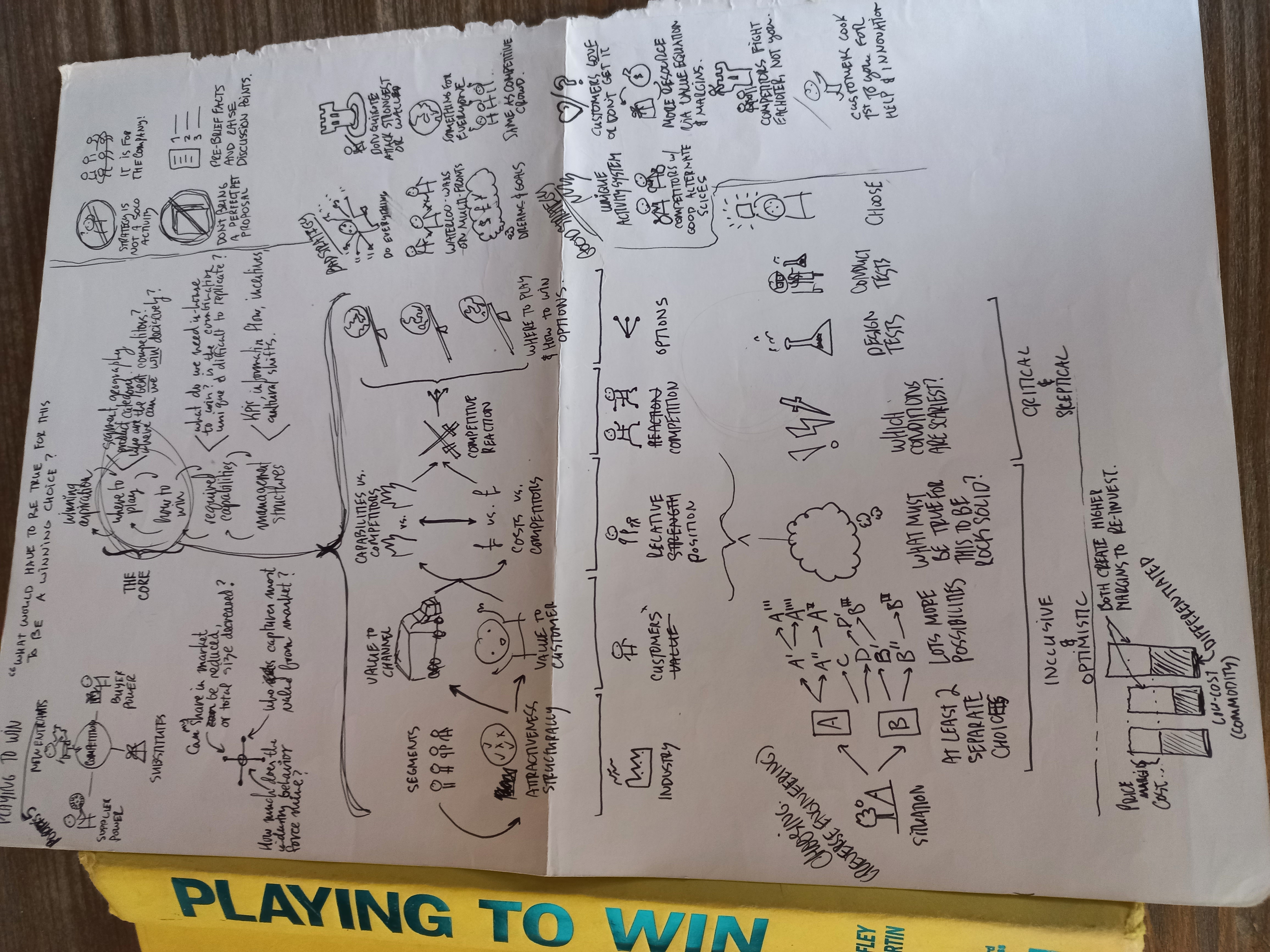
Given my spotty memory of the book’s contents (I never spent enough time using its ideas in a wide enough range of situations), I was pleasantly surprised to have my old notes page fall out of the book and onto my lap when I opened it this morning. (These one-pagers are how I used to take book notes before I started writing on the pages themselves.)
There’s a lot of great stuff in this book. A couple bits are immediately helpful to my current predicament(s):
First, the requirement that after evaluating the nature of the situation, you MUST design at least two distinctly separate options (which each expand into many sub-variants). Like many others, I’m too quick to fixate on my “comfort solution” and end up a local maximum that misses the root cause.
Second, the killer question for identifying hidden risks, preconditions, and externalities:
What would have to be true for this to be a winning choice?
(I’m slightly startled that I forgot about this particular question, since I used to use it as my #1 go-to during pretty much every conversation I had about early stage startups, but I guess that is what the notes and re-reading are for.)
As a simple example, I decided a while ago that it was finally time to build an audience, which I would accomplish by repurposing content from stuff I was already doing (e.g., video clip highlights from podcast interviews and braindumps like this one about whatever I happen to be thinking, trying, or reading).
That sounds like a pretty sensible approach. Let’s run it through the question of:
What would have to be true sharing my everyday work-in-progress to be a winning choice?
First, I would need to keep going. Audience is a compounding asset with its value in the future, so there’s no point in starting that slog if you’re going to stop after just a year (or just five years).
Second, I’d need to be consistent. (Which immediately bubbles up some important concerns, since I am not a consistent person.)
Third, at least a subset of people would need to find it valuable or interesting.
Fourth, I’d need to actually share the stuff. Which I’m not doing.
And then the followup question of:
Which requirements or preconditions are scariest?
The “scary” ones, for me, are the second and fourth requirements: consistency and actually posting it.
For example, here is a folder of fifteen video clips (one is a duplicate) — all edited, polished, subtitled, and ready for posting — that I haven’t actually posted:
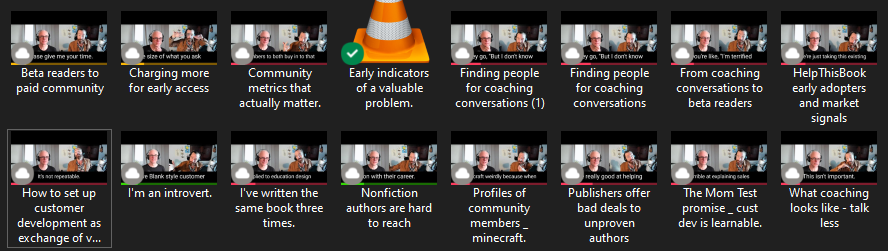
Instead, I’ve been sitting on these clips for months, which obviously isn’t ideal.
So that’s a case where the whole “strategy” is destroyed by my reluctance to pull the trigger in the final moments.
Which offers me a more specific “situation” to recursively run the process on:
What would have to be true for me to actually post the stuff I’m making?
Make different stuff? Change the platform or medium? Find somewhere that feels more private to post it? Remove myself as a gatekeeper via the brute force application of absinthe? Automate or delegate the posting? Simply do better?
I don’t know (yet), but those feel like more fruitful questions to be asking.
Comments (7)
I have similar concerns as your 4 concerns. Thanks for breaking it down this way. Makes it easy to follow.
Mine is 2 concerns and definitely inward focused
1. Consistency - same for me.
2. Getting things wrong or fear of looking bad — I think I don’t mind some small group find it interesting. I worry about getting it wrong by those who do find it interesting.
Rob, thanks a lot for sharing this. As a fellow ADHDer, I feel heard.
The evidence does not agree with your assumption that you are "not a consistent person." On the contrary, you've published three books and are working on a fourth, so you've proven that you can write with an amazing degree of consistency.
It feels that you are misattributing the problem to Sloppiness ("I am not a consistent person") when in fact, you have a Broken system ("I need a system that works for my ADHD brain.").
What do you think?
I like what wrote. Another possibility that explains the symptoms but I don't think is true for you necessarily, is that you misdiagnose a difference in degrees with a difference in kind.
As in you're consistent by objective measures (hence in kind) but in your mind or by your standards, you're not consistent enough (a matter of degrees)
This suggests
1. some kind of high standards (causing you to discount or dismiss moments of consistency)
2. poor recall (not remembering or recalling moments of consistency)
I like what Sierra wrote about 95% reliability on pp 151 of badass book. Perhaps you can tweak that 95 advice but for consistency.
Coincidentally i am also on a journey of reflecting on my scheduleCoincidentally I started my own root and branch analysis of my scheduling about a month ago after inspired by a stray line about critical reflection in a youtube video about studying.
So i hope this lets you know you're not alone in trying to change.
This time, instead of being full of analysis, activity, and ambition (my usual pattern), I went against pattern by totally emptied my schedule and paused all my projects and then resisting to quickly fill the void.
Schedule wise, during this period, I only do the absolute minimum to meet external obligations and allow only 1 week-level priority per week and 1 day-level priority per day. I am very careful about putting stuff in now. Maybe that explains why I've been able to attend the weekly writing sessions in the first place so consistently :D
It's been a month now and I'm still in this reflection, relatively empty-schedule mode. I'm resisting the discomfort of being underemployed and have no predefined target of when to end this reflection period. It's highly counterintuitive to our OKR, KPI, metric-centric modern mindset. For unexplained reason, I am going to see this through to the end.
Hm... I think there's a hidden time horizon variable... I feel consistent and capable on a stuff that happens slowly, on a yearly/quarterly tempo (books, products, learning), but I always feel inconsistent and behind on stuff that requires a quicker weekly/daily tempo (email, management, marketing).
On longer timelines, I my natural interest/energy levels to dictate what and when I work on, and I allow myself plenty of time away from any given task when I'm not feeling it. Whereas on quicker tempos, I feel like I'm spending a lot of time "forcing" myself to do stuff that I'm in the wrong state of mind for.
I'm now wondering if (and how) I can map/reimagine my current work requirements onto a slower tempo... I think I'd be overall happier and more productive if I could do so.
That all rings very true to me, and is similar to how I work when I'm working solo. But now that I've got a team and management responsibilities, I'm finding it a lot tougher, since I often end up being a bottleneck for other people's work. But maybe it doesn't have to be all-or-nothing, and maybe I can loosen the constraints, as you suggest, to find a happier middle ground.
Let us know how it evolves
I no longer over react to these moments or periods of “things not working”
As in over react to them being bad.
I see it more as reality is trying to tell me something and I need to hear what reality is trying to tell me
I know that sounds woo-woo crap 💩 which I hate but I now see it as the case. Im sure you’ll eventually evolve out of this current period of overwhelm
That makes sense. I think that it all goes back to creating a system that works for you. Ideas:
• Content marketing fits really well with a slower tempo if you produce content in large batches and schedule it for automatic posting on future dates.
• For management, I like Cal Newport's idea of publishing office hours schedule to let your team know when you're available. This can limit the interruptions.
• You can try to delegate all time sensitive email to your team.