Bias is never 0%, validation is never 100% // Context and pragmatism in custdev
After reading about custdev, it’s tempting to want to do it perfectly: to remove every bit of bias, to ask perfect questions, etc.
But sometimes the bias is completely outside of your own control, created by the context itself. For example, being forced to meet in a formal setting (or with multiple people) will always introduce more bias:
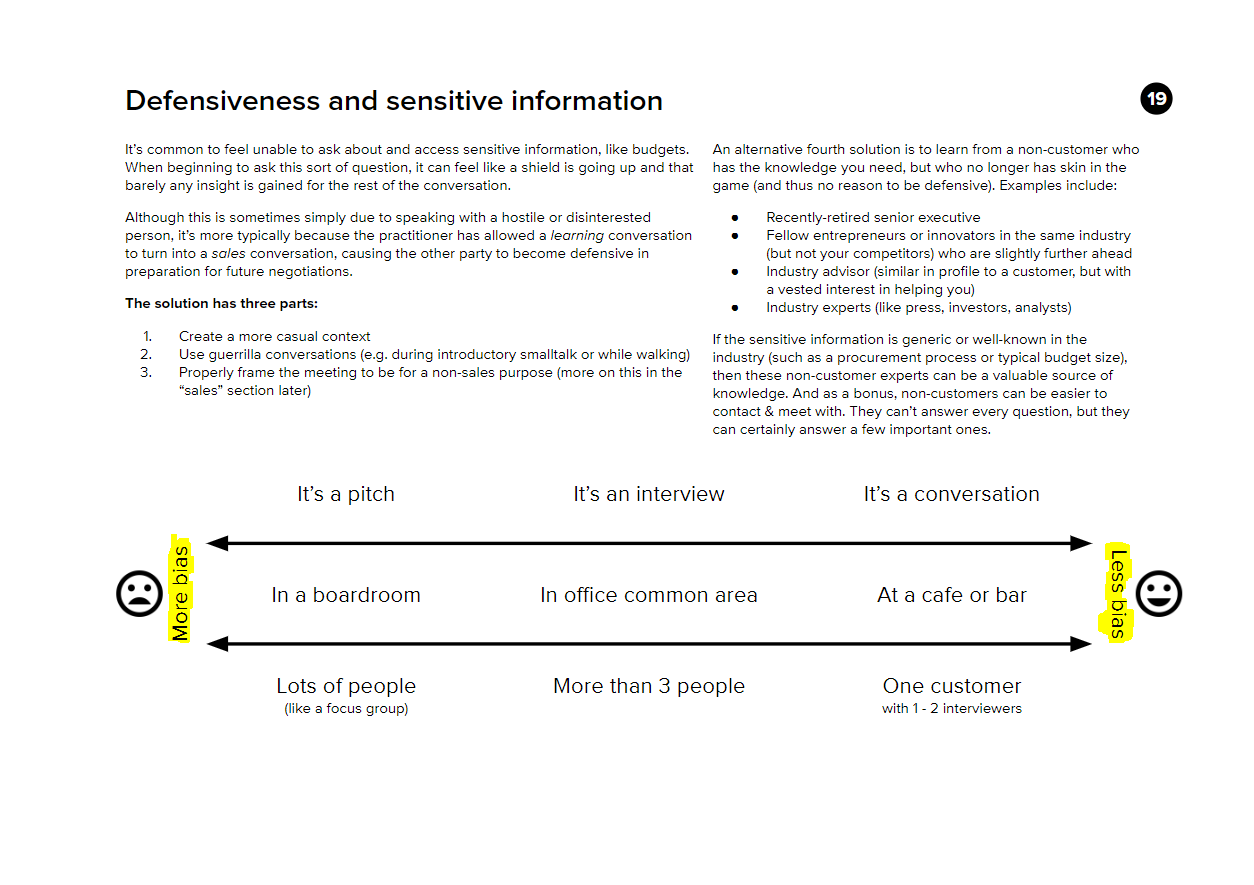
(Image above excerpted from an old workshop workbook of mine.)
Similarly, if the person you’re talking to is having a bad day, they will always be more closed off, more defensive, more rushed, and less willing to have an open-ended conversation.
Or the person may be getting off-track, and you need to nudge the conversation back onto a certain topic, which requires a fairly forceful/directed question.
This is all fine, so long as you’re aware that it’s happening. The idea isn’t to get 100% clean information, nor to improve your certainty of being correct to 100%. (Both are impossible).
The idea is to:
- Slide the conversation as far toward the “unbiased” side of the spectrum as you are able (which may not be anywhere close to 100%, but is still better than it would have been otherwise)
- Recognize which specific bits of data are good/clean (and which are bad/biased), so that you can pay attention to the right bits and ignore the rest
- Given the above, to be able to make sensible trade-offs between investing your time in learning vs. doing (which often involves picking the low-hanging fruit in terms of learning and then trying stuff)
Another consideration is that some types of business ideas are fundamentally easier to validate than others. (This is part of the shape of the idea; if you want higher pre-product confidence, you can pick an idea that allows for it.)
For example, if you’re building some new application for 3d printing, you might be lucky to get to 10% certainty via conversations. If you’re building problem-solving apps for business, you can easily get to 80-90% certainty.
This isn’t an excuse for running sloppy conversations. But it’s a reminder that the context will often constrain how much learning is up for grabs.