Engagement, growth, & local maximum for community-building // Resisting the common KPIs // Why OOCs are rare
For the sake of this post, let’s organize the umbrella term “community” around members’ reasons for joining:
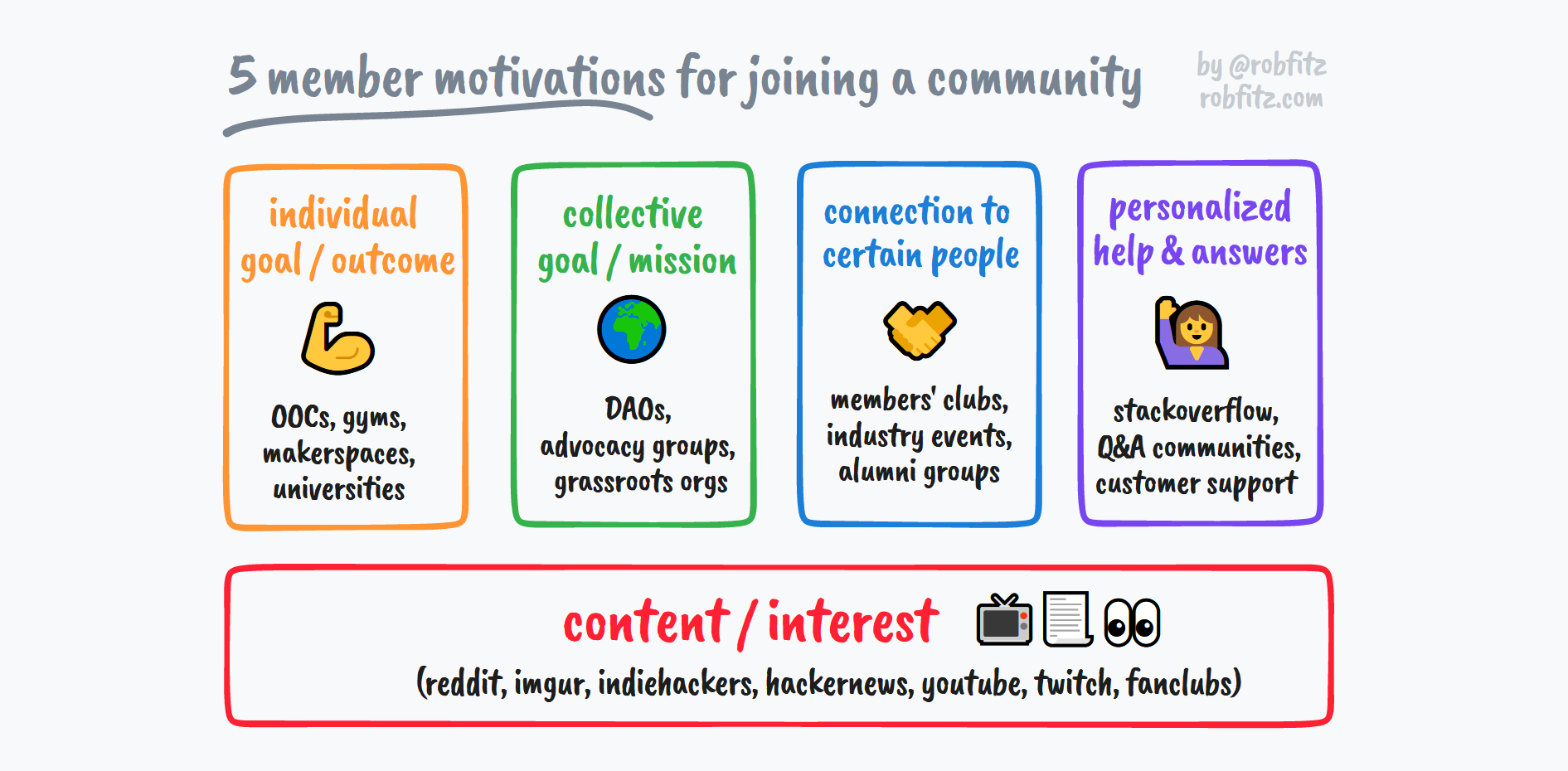
Startup KPIs/metrics (and thus community KPIs) are normally: retention, growth, and engagement.
But in the diagram, the top four community types are all defined by REJECTING one or more of those common metrics:
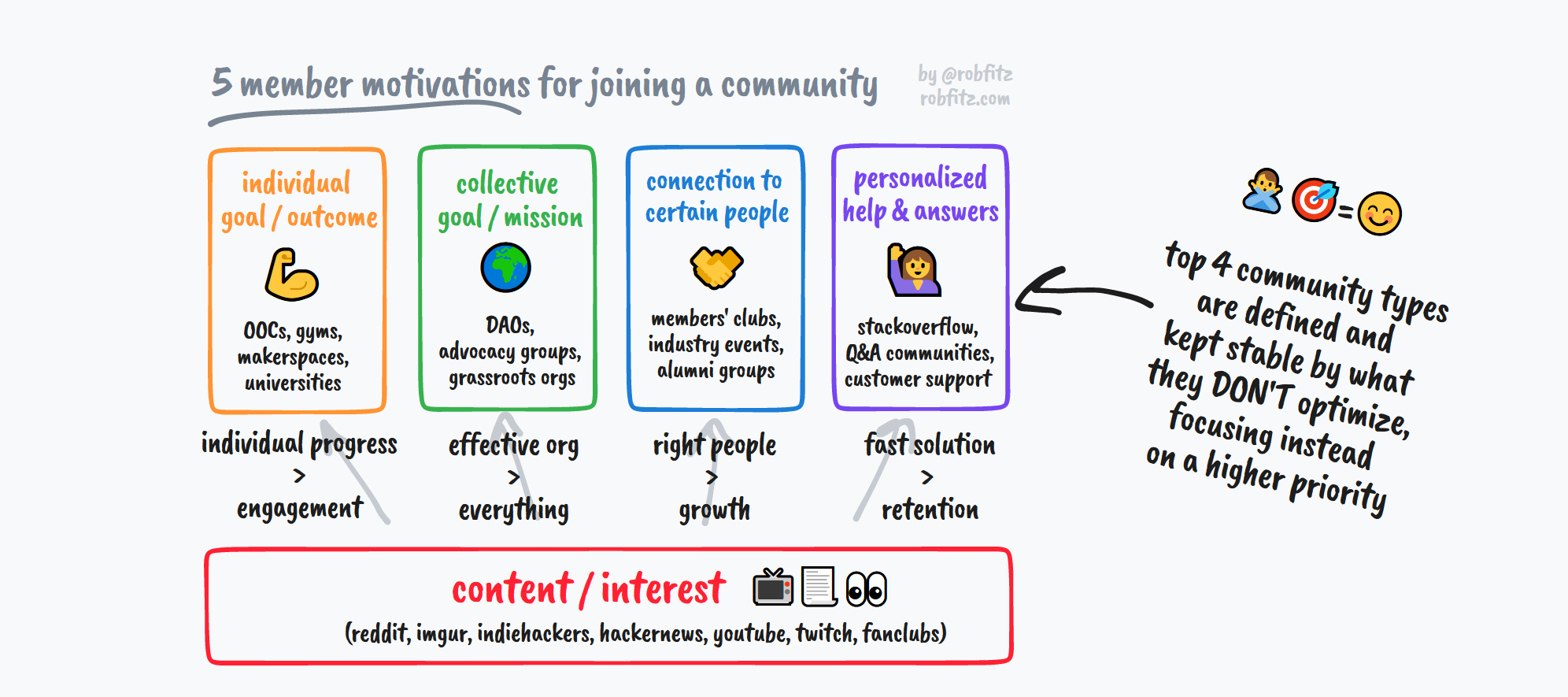
Many community-builders start out with the intention of building one of the upper types of community, only to find themselves somewhat surprised to have built a content site.
For example:
IndieHackers began as outcome + networking (i.e., start a profitable indie venture + connect with other indie founders). These days, it’s degraded into a content community, mainly helping self-promoters to market themselves to aspiring self-promoters. I doubt that anyone in control made an explicit decision to do this; they just followed the metrics, and this is what happens.
Facebook began as personal networking, shifting into a content/interest community with the newsfeed, and is now, in the final stage of the transformation, de-prioritizing the social graph and reinventing itself as another TikTok (i.e., only content, no community). LinkedIn has followed Facebook’s journey (with a lag of a few years) from a meaningful network into a noisy content site.
Assertion: optimizing for the obvious metrics will cause every type of community to either die or become a content site:
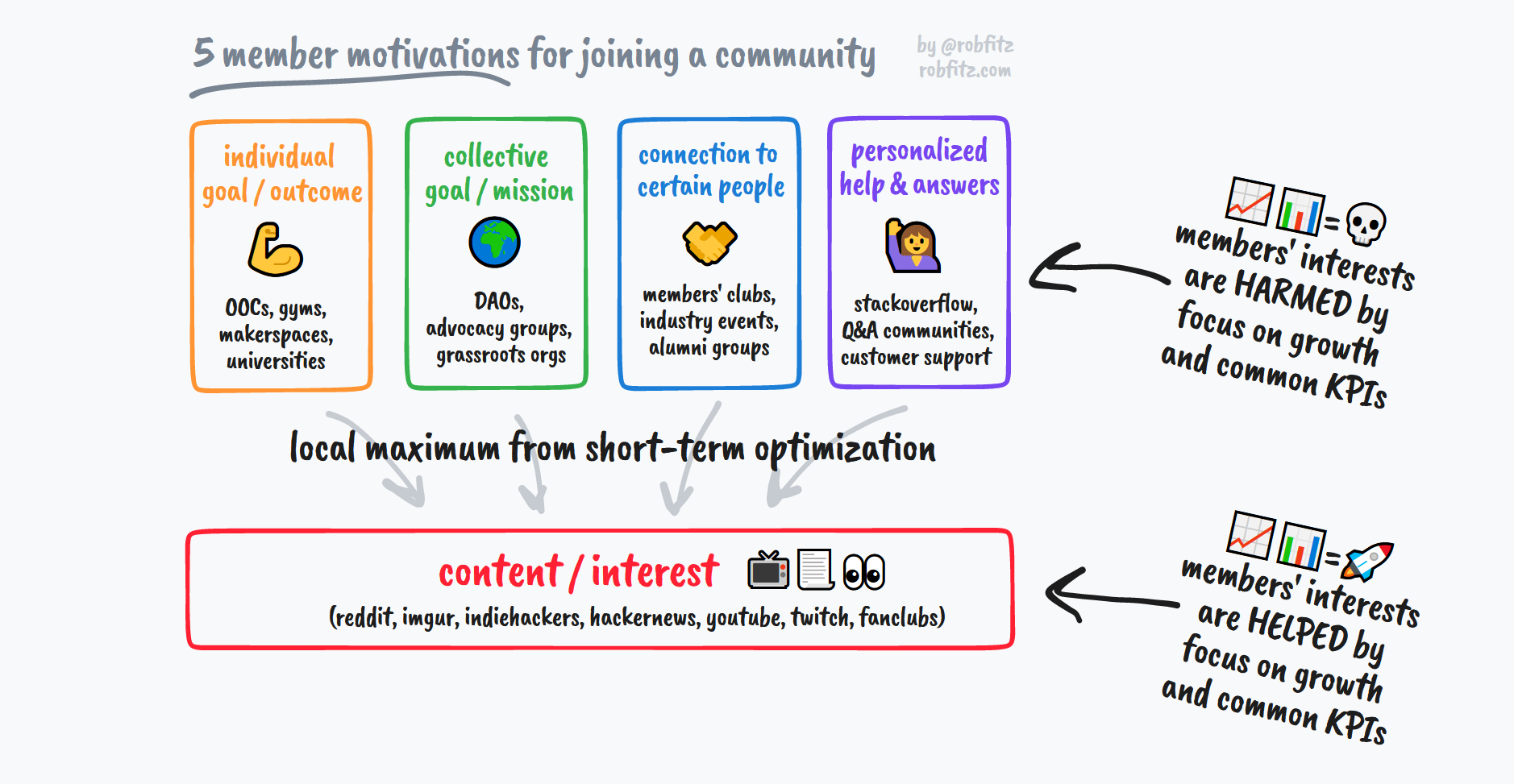
StackOverflow has held the line better than most, but the tension is still visible. You arrive seeking a quick answer, and they force you to sign up. Fine. Then they start emailing “related content,” begging you to return. But you didn’t join for content; you joined for a quick, personalized solution. So their outreach feels like (and is) spam.
Nearly every successful conference and meetup ends up collapsing under its own weight, stepping onto the slippery slope of optimizing ticket revenue or sponsorship until the event’s value to its original members has been hollowed out and it becomes a content/eyeballs/engagement business. Just look at TED.
I used to think of this rise-and-fall as the inevitable life cycle of events. But it’s actually a preventable consequence of a certain type of leadership. While this blunder can be self-inflicted by almost anyone, it’s practically inevitable after raising funding (since fundraising forces a growth focus).
Do these companies care? Who knows. Maybe they only want that bling-bling valuation. In which case, sure, fuck it, everything ought to be a content site.
But if you’re starting your community for a more rarefied purpose (like helping your members or helping the world, for example), then you must resist the easy metrics.
One of the tricky things about OOCs (outcome-oriented communities) is that member engagement is SUPPOSED to be low. If your members are spending too much time reading your content and checking your notifications, then they aren’t making progress toward their goal! Engagement in an OOC should be like engagement with a gym, therapist, or coach, where small doses of focused time can unlock big progress elsewhere in the members’ life and work, out in the real world. A therapist who optimized for time-spent-in-my-office would be a psychopath. And yet community-builders do this all the time…
Stay focused on the reason why your members originally showed up (and how you originally intended to help them). That’s your KPI.
Comments (6)
There’s a tweet by lessin detailing how he thinks social network (or content site as you call it here) will end up being
https://twitter.com/lessin/status/1551931628305502208?s=20&t=ba4ke8X6sJ0K6zXhGOBa5g
That tweet just makes me think that content at the biggest companies has been weaponised to become addictive drugs
I’m not against content per se. I’m against creating addicts.
It’s doubly hard to set KPIs in OOC because
1) some content is definitely required but not zero so what’s the bare minimum that’s enough?
2) true impact lies in members lives being changed and they are often hard to measure and usually lagging indicators of your community site actions
It’s just easier to measure enegagment it’s leading indicator and it’s the more the merrier. You don’t need to think of not too much or not too little.
No wonder it’s people from Silicon Valley who worry about AI are also the ones who use the paper clip AI as the example of bad AI.
Is the same kind of naive, simplistic pedal to the metal of chasing a goal to its extreme logical end
This piece just said what I have been thinking of but couldn’t articulate
Choosing OOC is the harder goal in a way
Really nice summary from lessin, and I find myself encouraged by the postscript at the end (in yellow): [image.png]No matter how many inspirational fitness videos exist (entertainment/infotainment), a good personal trainer will still always be in demand (accountability/progress/outcomes).
Good catch on the post script.
i keep gravitating towards the same improvement business myself as well. and also draw encouragement from that
This was a very insightful observation, as the dynamic towards content and self-promotion is something I've seen for myself in other communities. Also in paid ones.
I was wondering if it had to do with growing beyond a certain size, which means the self-promoters inevitably see their opportunity?
I see it as general incentives thing, which can shake out in a few ways:
1 // If a community is small and elite, it can attract service providers like coaches and consultants who see it as a pool of qualified leads. interestingly, this isn't always a bad thing, so those folks can add massive value and expertise if they are considerate and generous. we have a few in the Useful Authors group who add a lot of value, add a lot of value, and have ended up with a few clients despite the fact that they never actively self-promote.
Two ways to solve this are 1) to moderate away any self-promotion (heavy-handed but necessary in some cases) and 2) provide a release valve where they've got some official and appropriate way to tell people that they are service providers. In the Authors' group, as we grow, I plan to create a way to do this, either a service providers space within the group, where members can announce their services (without it appearing on the homefeed or emails), or by a tag next to their usernames that leads into their profiles.
2 // If a community is big, it will always attract marketers and folks looking to drive traffic. Again, this can be a good thing (since you usually do want good content and engagement), but it can also go far too far. If the community is a content community, then this is sort of the point of it all, so you encourage it and let it happen.
If it's a different kind of community, then you want to de-incentivize it by making self-promotion less rewarding. We do in Useful Authors this by not including external links in the newsletter (since otherwise people would be incentivized to keep linking to their own stuff), and by having some spaces where links can be posted (like the resources space) that don't always appear in the homefeed. This allows the action while reducing the self-promotional rewarding, which means that people only do it if they're doing it for the right reasons (i.e., helping other members or having an interesting discussion).
Probably lots of other options, but it's basically about raising the incentives of the desired version of the behavior and reducing the incentives of the non-desired version. IMO anyway ;)
So the OOC is a medicine or doctor's appointment to troubleshoot certain things, getting feedback, and perhaps meeting other likeminded people within reason.
ie. it's not a place you hang, it's a place that helps you move forward?
I feel that with the OOC! but I now realise that I am definitely not building that in my Community.... I was building a content site. 🤦♂️