On slogging through a learning vacuum // Balls of steel // Sloppy strategy
Slogs are the moments in a startup journey where there’s no way through but through, and you need to commit hard for an extended period of time, *without gaining any new data along the way.*
A common example is a content-heavy SEO strategy. How do you test that? Writing ten articles won’t move the needle. So you need to write a hundred (or more?) before you’ve got enough data to make a real decision.
Another common slog is “UX as competitive advantage.” Your v1 product has terrible user metrics. So do v2 and v3. But over time, those incremental improvements add up into a transformationally better UX, and everything starts to click.
Of the Six Modes of Learning (made by Devin and myself as a better way to think about and teach MVPs), *slogs are the most misunderstood.*
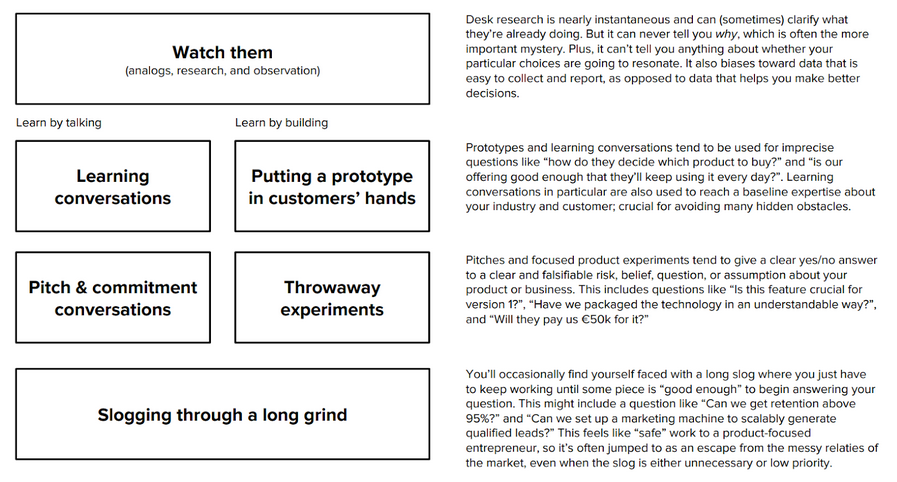
For example, the Lean Startup folks like to pretend that slogs are never required, and that you can always find a more clever way around. At the other extreme, some product-focused folks like to pretend that everything is a slog, and that the only way to get any real learning is to just pull up a chair and do the work.
Here’s my take:
Compared to other modes of learning, slogs are extremely expensive.
Being wrong on a quick and easy experiment (like a prototype or customer conversation) is a helpful lesson-learned. Whereas being wrong on a slog is a company-killer.
As such, you should never voluntarily undertake a slog when a less risky path can be used to reach the same destination. (This isn’t a new idea: a huge portion of modern startup theory is about finding clever ways to split one long slog into a series of smaller steps that each provide a bit of learning. Which is great when it works.)
But sometimes there’s no way around, and sometimes the slog is necessary. And when that happens, you’d better be prepared for a long and difficult journey, because there’s no prize whatsoever for getting half way.
I love these quotes from Max Levchin about how to know whether your algorithmic underwriting system is going to work (via Steven Buccini):
The honest answer is you don’t [know if it’s going to work].
And the only way of building [one of these systems] is rigor and, for lack of a better term, balls of steel.
Balls of steel. Because not only are you burning through your time and money at a worrying rate, you’re gaining zero extra confidence while doing so.
For six or twelve months in a row, your investor updates are the same: “We’re still doing that thing.” They won’t like hearing that, and you won’t like saying it.
And again, if this slog could have been avoided, then you deserve their displeasure, because you’re running your company like a dummy.
But sometimes the slog is necessary, and getting through it is itself a defensible moat, because most companies can’t stomach it. Here’s Max again:
Of course, it’s very hard to build models from your own data if you don’t have a lot of data, and the only way to get a lot of data is to lose a bunch of money.
[…]
That means processing a lot of transactions and bracing for impact because a lot of the transactions are gonna go sour.
One of the things that happens for a brand-new launched credit card: done right, you lose about 50% of the dollar volume in the first several months, which is terrifying.
Slogs are real, and it’s important to be honest with ourselves about them.
They’re a common point of discussion in my strategy meetings with Devin. We get all excited about some new idea, and then we pause and say, “This is going to be a slog. Are we up for that right now?”
Sometimes yes, sometimes no.
For example, we said “yes” to the slog of fueling our marketing primarily via video content. We’ve now spent dozens of hours and thousands of dollars on that, with essentially zero metrics to show for it. And we’re fine with that, because we got into this slog intentionally, and that’s how slogs work.
But at the same time, we’ve (temporarily) said “no” to the slog of publishing, because we aren’t quite ready to commit the $250k and three years required to accumulate a meaningful catalog of titles. Instead, we published two books as an operational experiment to help us understand the costs, and we’ll pick it back up once we’re ready to commit to getting through the whole slog. ** Slogs are expensive. **Undertaking an unnecessary slog is sloppy strategy. ** But even worse is **failing to recognize that you’re in a slog, expecting magic metrics after a week or two, and then giving up halfway. Because while sloppy strategy might still work our (just more expensively and slowly), doing half a slog has zero chance of success.
Comments (7)
This article fills a big gap between the Lean Startup crowd and the Big Projects fans. I'll incorporate this into my teaching (with attribution, of course).
Do you have more material on the Six Modes of Learning?
I think that the key point is that although you can get data on leading indicators during a slog, getting data on the lagging indicator that you are actually trying to move can take a long time ("People are consuming our content, but will that lead to conversion?"). That's why they are called lagging indicators after all. :)
What do you think?
I do, in fact :). I'll email you directly with a 40 page PDF that I made in an attempt for teaching this stuff to scientists, but without all the buzzwords/pushback/blunders that Lean Startup tends to invoke in non-techies.
I had always planned to expand that core workbook into a full book, but I never really got there. Maybe having your eyes and thoughts on the core material will help me figure out what to do with it next.
can i get an email as well? and is this a book already? i realized i pick hard slogs too often now that i see the schema you created above. it's useful
Absolutely, I'll get the early version over to you :)
Sorry did you send it over? i checked my spam and don't see. just wondering. no particular hurry.
Would love to read this as well.
I'm late to this, but would also love to see the 6 modes PDF if that's available.