On the early days of community-building // Quiet af // The content & concierge stage
The early days of community-building can feel like being a nervous party host:
Will enough people show up? Will they have enough to talk about? What if someone arrives an hour before everyone else? What if they get bored? Will they ever return?
Early on, there’s just not enough going on to keep the system moving. It’s like a pump that has run dry. (Or as so eloquently put it, it feels “quiet af.”)
It’s perhaps reassuring to realize that this isn’t a “problem” so much as an awkward growth stage that every community goes through. It feels acutely unsustainable, but you aren’t supposed to sustain it; you are supposed to survive and outgrow it.
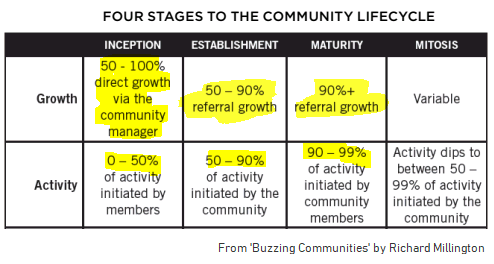
This early struggle is so common as to be well-defined in the literature. In Buzzing Communities (sample PDF), Richard Millington defines the first stage of community by its lack of member-generated activity, saying that it’s the community-builder’s job to contribute 50-100% of the discussion (and growth!) during these early days:
Millington explains:
For your purposes, critical mass is when the level of growth and activity in the community continues to increase without your direct involvement.
This point is numerically defined as when more than 50% of growth and activity is generated by the community (as opposed to by you).
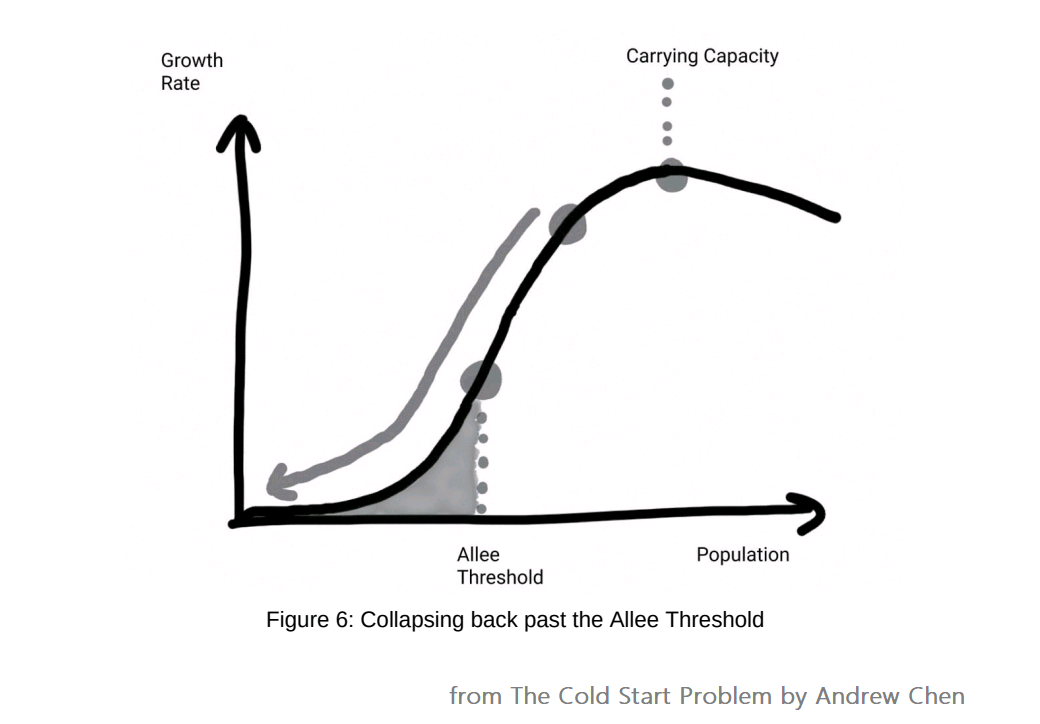
Similarly, in The Cold Start Problem, Andrew Chen defines this pre-stability stage by the network’s tendency to backslide to zero if left alone:
So (1) every community goes through this awkward stage and (2) you must get through this awkward stage. As Churchill put it, “If you’re going through hell, keep going.”
The strategic goal is fairly straightforward. Here’s Millington’s take:
The sole goal of the inception stage is to achieve critical mass by cultivating a small group of highly active members.
And Chen’s description of the same goal:
The solution to the Cold Start Problem starts by understanding how to add a small group of the right people, at the same time, using the product in the right way.
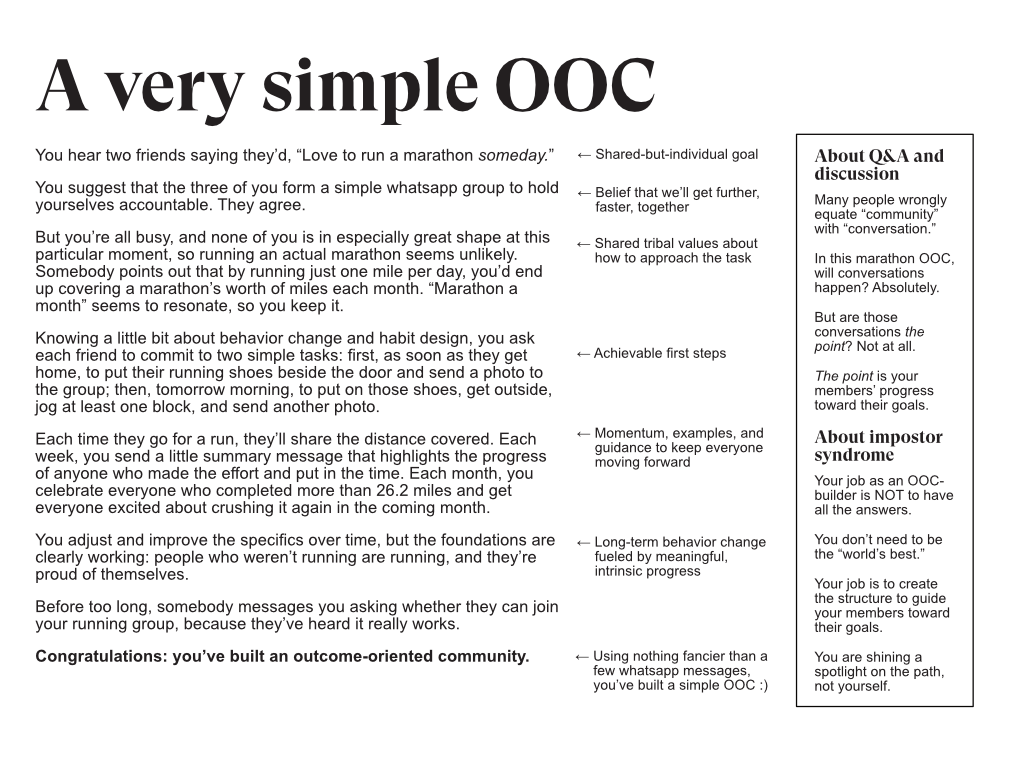
The “right people … in the right way” gets a bit easier thanks to the shared “outcome” of an Outcome-Oriented Community. Also, the “small group” can potentially be very small, as described in the “smallest possible OOC” thought experiment:
In any case, you still need a tactical plan for getting through the early days. Some options and tactics for doing so:
- Conversations: instead of answering every question yourself, answer one member’s question by tagging in another member who has experience in that area
- Newsletter: instead of relying entirely on highlighting member activity and success, plan to create at least one “big” content piece per week as the focus of the email (in an ideal world, this will also double as either marketing or knowledgebase)
- Stories and wins: instead of hoping for members to share unprompted, follow their progress via twitter/linkedin/etc., and give them shoutouts when they’re crushing it (or go even deeper with a post about “what I learned from watching [person] do [thing]”)
- Posts: be the member you want to see, regularly sharing your own progress, challenges, and research with maximum transparency
- Progress and outcomes: play the part of a volunteer coach or consultant, do 1-on-1 checkins via DM, ask if you can use their project as the example in a breakdown/analysis video, and basically get directly involved
Good system design is a multiplier/accelerant to all of the above, in the sense that a well-designed community will require fewer people to feel healthy and self-sufficient. (And a sufficiently poorly-designed community may never feel like it’s solid, no matter how much is happening.)
Still, one should also never forget the brute force solution: to move fast, survive, improve as you go, and outgrow the need for doing quite so many unscalable, concierge activities.
To drive home that point about the importance of growth, consider what would happen to the Useful Authors’ active membership (left) if we suddenly stopped getting any new members (right):
The first eight months are the same. But without the arrival of any new members after that, it starts to look pretty grim pretty quickly!
We obviously intend to further improve retention (and I’m working on some ways to do so). But even if you were doing everything absolutely perfectly, members would still come and go (and the activity and contributions of subscribed members will fluctuate).
This is true for any living system. But once you past the quiet af early days, at least the the new arrivals show up organically from your other members (and/or systemized marketing), instead of relying on you doing everything yourself.
Comments (17)
I am definitely nervous. Or more accurately, fearful. Now I look back at my past few weeks of work, I can safely say 80-90% of it is fear-driven yak-shaving
And yet it's not a complete waste of time, if I draw the right lessons from that period.
One of which would be, "oh, so this is what I look like when I am starting a community and feeling scared."
"Yak Shaving"... Now at least I have word for that "I just need to implement one more feature before I can launch" syndrome I'm currently stuck with. Trying to create the perfect customer experience without having any actual customers yet...
This should definitely be a whole chapter in your book, maybe 2 :)
i like your idea. in fact should pair with the story about the 12 weeks of eating alone before starting up a London startup event story
, : That's in my mind as well. I'm thinking of it as a "writing in public, directed by the questions/experiences of the OOC group." In the last few weeks, a few of us have been feeling stuck in the early bits, so I figured it was worth taking the time to collect my thoughts for that group now, and for the book eventually.
damn, very well put!
I've spent some time researching this topic, going back to the "early" days, e.g. how Digg was built out. I remember reading about this from Paul Graham and various comments on HN about this. I like your explanation much better than what I read from the above sources or the various interviews with those founders. In my mind, the Outcome-Oriented part really helps to focus on being mindful of the required patience and thoughtful growth tied to specific outcomes. What I kept taking away from the HN comments and the various interviews is more about pushing lots of content, without considering the impact of that content on the community.
Maybe I'm completely missing the point or misinterpreting?
Everything you write here rings very true to my own experience. Lots of creating content myself and slowly others start chiming in, and now to the point that other members in my community provide the majority of the content. Yes, tagging other members is so much more effective than simply trying to answer every qestion, when in truth I sometimes have no good answer, but I know there are others who do.
I think it's just different approaches for each different type of community: HN/reddit/digg are all content-centric-communities, with the typical user breakdown of ~1% post, 9% comment, 90% lurk/consume. So in those cases, "astroturfing" (i.e., fake accounts and content) can be essential seed the "1% content" that the other 99% either consume or react to. Whereas in an OOC, that would be a pretty backwards approach, since theoretically everyone in an OOC is "participating" in the sense of making progress toward their goal. Less like a content site and more like a gym or woodworking studio.
I’m revisiting this post after a deep conversation with two friends who are ambitious thoughtful people who have experience being in paid communities as members
Now revisiting this post after last night conversation I find this post even better than my initial recall.
Some movies are best watched once. Others get better with each rewatch.
This post is like those movies that get better with each rewatch.
Caveat is the reader needs to bring lessons from their daily lives to this post
Reminds me of that old joke about how a man finds his parents being much wiser as he aged from his 20s to his 30s
What struck you differently on the re-read?
It's all colored by my recent experience of talking to people what I've been doing with AF.
Take for example,
“> Conversations: instead of answering every question yourself, answer one member’s question by tagging in another member who has experience in that area”
The word "Conversations" in this line reads very differently for me now.
I have been showing 1-2 friends 1 article of what I wrote in my own community based on my knowledge of them being interested in the topic, and they have given me some interesting feedback sparking new conversations.
When I do this,
• Worst case scenario, I reconnect with old friends
• Best case scenario, they join as members.
• Usual case is something in between. We have conversations that spark in me new questions. Which I can then reuse for future content. So less of a writer's block.
These conversations they linger... and when I read something elsewhere for pleasure, I start to see how I can repurpose what I just read + what I conversed with friends off-community, and this led to new questions and content I can write about for future posts in the community.
It doesn't even feel like work.
Another example
“> how to add a small group of the right people, at the same time, using the product in the right way.”
I know what this means right now. Because i made two new friends recently and last night I just had my second zoom call with them.
And the conversation just flows. And they, without me prompting, actually went to look at my AF writing and came back to challenge me about the costs of running a community and what's the specifics of Autonomy.
Now we may end up doing zoom call on a regular monthly basis.
In short now when I read in this article, it feels like a different piece altogether.
Because it feels like now for almost every important point in this piece, i have a concrete real-world example. So it no longer feels as theoretical.
Also after writing the above down, i feel like summarizing as:
1. meet people where they are. not where you want them to be.
do i want people to join my community? hell yes. but some people in my life, they are just happy to have casual conversation about this topic in private messaging or zoom call sand never join my community. I should be open to that.
2. Don't do a "in-order-to" when interacting with people.
While I'm pretty introverted, it turns out i can be pretty chatty under the right conditions. One of which is i need to be relaxed and in a neutral/positive mood.
Building a community is in the same region as interacting with people, albeit async.
People can sense even across time and space through the content, your vibe. This sounds woo-woo, and I'm generally against woo-woo, but there's something there.
If people sense I'm trying to get them to join my community when i reach out to them, rather than genuinely asking, hey I wrote this and we kinda talk before about this topic, what do you think? i think i wouldn't have such good vibes.
[220F7BBF-D9BC-4D12-94BD-D84425B0A1E0]
Not sure if I’m over extrapolating but for some reason I went to re-read your write useful books
And this hightlight part stood out.
I now see that I give a bigger deal about the topic of autonomy hence I got more of it going than my book project in useful books.
Which is point 3
I also can find at least 1-2 people in my life I can talk abt this topic genuinely even if it’s off-community. Which is point 2.
The bigger meta point I’m making is reading experience is an interaction between the objective book/content and the subjective state of mind / life experience of the user / member.
Even the DEEP framework and the sequence of earlier part matters first can also be applied to OOC
I’m into speculative territory here but I think the difference between a useful book vs a OOC is that a book can be instantly useful via words alone but OOC cannot.
Or as you said in a separate post it’s about behavior change partly
so like here in the ooc-ooc, it’s more worth having a few voices in a tight knit community, than a sprawling community including accounts that aren’t actually active?
Does it perhaps also counteract social-media-jadedness(the feeling that accounts are either not real, and/or only there to promote themselves or a product)?
“> in an OOC, that would be a pretty backwards approach, since theoretically everyone in an OOC is "participating" in the sense of making progress toward their goal. Less like a content site and more like a gym or woodworking studio.”
Put this in your book, pls
the "astroturfing" part makes perfect sense. I completely forgot about that term, thanks for the reminder :)
I can see how the different types of content in those types of communities would drive the interactions. In the OOC community, is there a need to "seed" it?
I'm guessing it's a "no", since the interactions on specific topics are the main drivers. This is in addition to the heartbeat topics and other rituals. Is this correct?
Lastly (🙂) would this change between something like an online school vs something like your book writing community (skill building?) ?