Seven modes of struggling // debugging with the time dimension
As I was attempting to debug the nature of my current calendar crisis, I ended up thinking about root causes and possible fixes through the lens of past/present/future mistakes, which combine into seven permutations (i.e., the seven modes of struggling).
It’s proving helpful for me, so here it is. (If the diagram feels incoherent, a written explanation follows.)
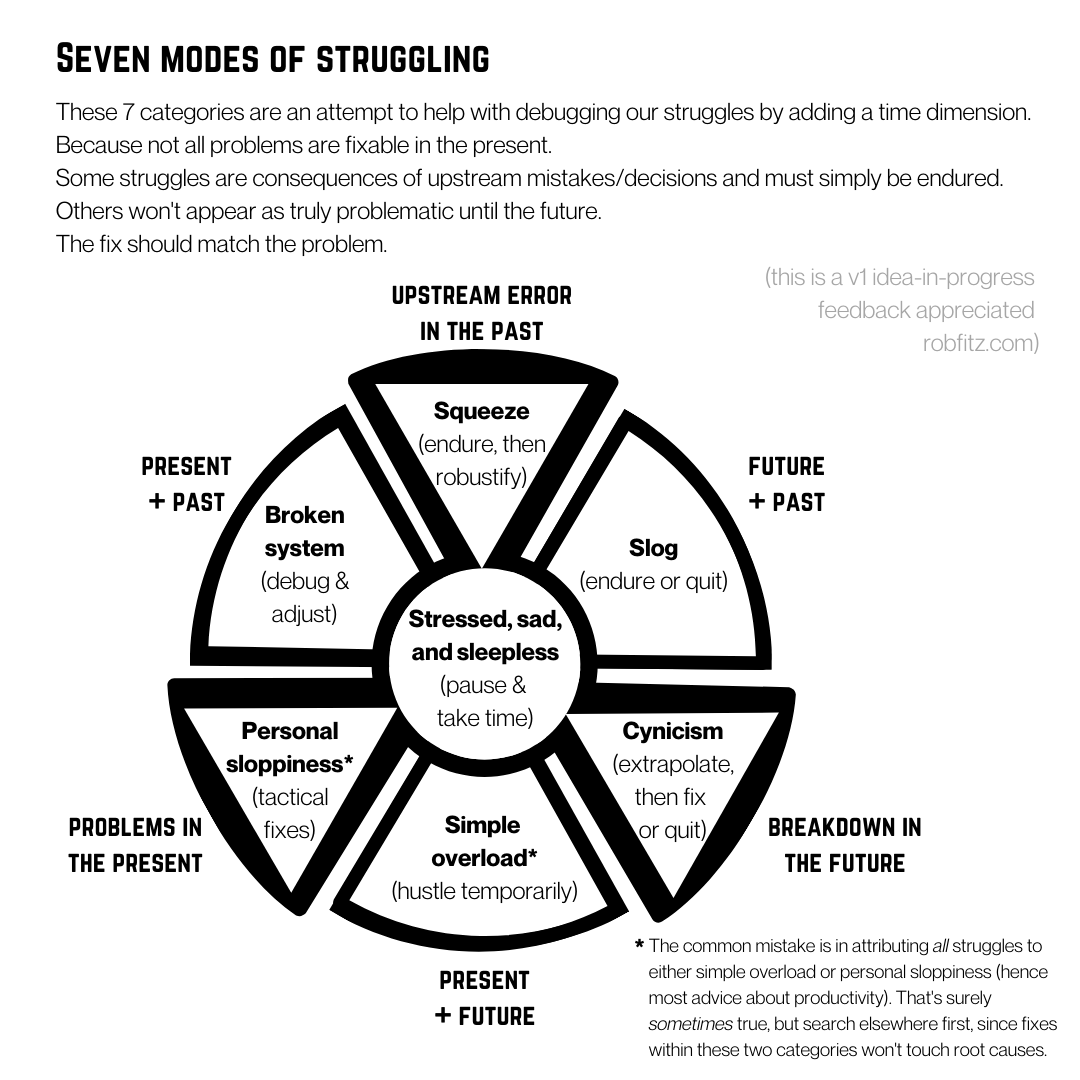
Squeezes from upstream mistakes [past]: when you’ve made a mistake in the past that now puts you in a situation without leverage, where the only real choice is to grin and bear it. A common example is missing an important flight (perhaps due to an overly fragile/optimized commute) and then needing to pay whatever is asked for a ticket on the next plane. Or accepting too many commitments that have now combined to crush you.
Slogs [past + future]: this is when you’re in the difficult middle of a marathon, having already suffered through lots of hard work, with nothing to show for it (yet). The decision to undertake the slog was in the past and the benefit of getting through it is in the future. Assuming that the slog was a good decision in the first place, then you just keep going.
** Cynicism [future]:** this problem exists in the future, because the today’s cynicism will only worsen over time. If you’re already starting to struggle with today’s bullshit and busywork, imagine how you’ll feel in five years. Design an immediate intervention based on that extrapolation.
Simple overload [present + future]: when everything is fine, and this is just a busy moment that you need to muster your energy to get through. The danger here is that you’re lying to yourself, and it’s actually one of the other problems. So while the problems exist in the present, one must also extrapolate into the future to identify whether the situation is likely to become better, worse, or remain unchanged. (If it’s likely to become worse or remain unchanged, then it’s not simple overload, and you should check the other issues.) ** Sloppiness and self-sabotage [present]**: when you’re simply screwing up and being ineffective. These mistakes happen in the now, and they can be fixed in the now as well. Most productivity advice assumes that this is the problem, but it rarely is. Coaching helps, as does all the standard advice about self-management and getting your shit together. (Again, this one is often used as a superficial explanation, which, if accepted, will prevent you from finding and fixing more systemic issues.)
Broken systems [present + past]: can be debugged by root causing past and present challenges and trying to understand how your way of working (e.g., a culture of urgency, saying yes to everything, checking your email before doing your writing, etc.) is causing unforeseen second-order consequences. These may also be the unexamined underside of two-sided values.
Sad, stressed, and sleepless [past + present + future]: this is the most personal and dominates the other considerations. Pull the Andon Cord and take the time to examine past, present, and future, ideally with support and help from people you trust.I’m getting some benefit from this model, asking myself whether my current calendar pain is a temporary squeeze, personal sloppiness, a systemic problem, and so on. Maybe it’s helpful for you, too?
In theory, this should help with identifying the real issue(s) and designing the most effective intervention(s). (Written in plural since it’s very possible that mistakes are happening at multiple levels that each level deserves its own fix.)
Alright, that’s it. Stay well.
Comments (3)
I think there is an interconnection. A broken system can lead to stress/sleepless/sad, if one fails to resolve the underlying issue, cynicism will be the result. Unfortunately a stressed, depressed and sleep-deprived brain does a poor job at problem solving. So, putting this issue at the centre is important, because it overlaps with everything else. Taking care of basic needs won't resolve the other issues but not doing so will exacerbate them.
100%. The categories definitely cascade and overlap, and the lines between them are fuzzy. For me, where it's feeling useful is in forcing me to consider a wider range of root causes than my "default debugging" (which normally has big blind spots).
“Unfortunately a stressed, depressed and sleep-deprived brain does a poor job at problem solving.”
One of the authors in my writing group, Harry, described this situation as "going slower to go faster," which really resonated with me. It feels like the end of the world at the time, but, as you say, you need the rest to gain the perspective to identify and fix the real issue.
I am sorry but this does not make sense to me. The future is an illusion: all change is happening now. Something that happened in the past that is still affecting you now is happening in the present. Something that may become a problem requires a threshold monitor, watchdog, trigger to be set and monitored in the present.