The shape of an idea
An early draft of a little framework-in-progress for humanized idea selection.
The crux is to stop evaluating ideas on a spreadsheet and start evaluating them within the context of your life:
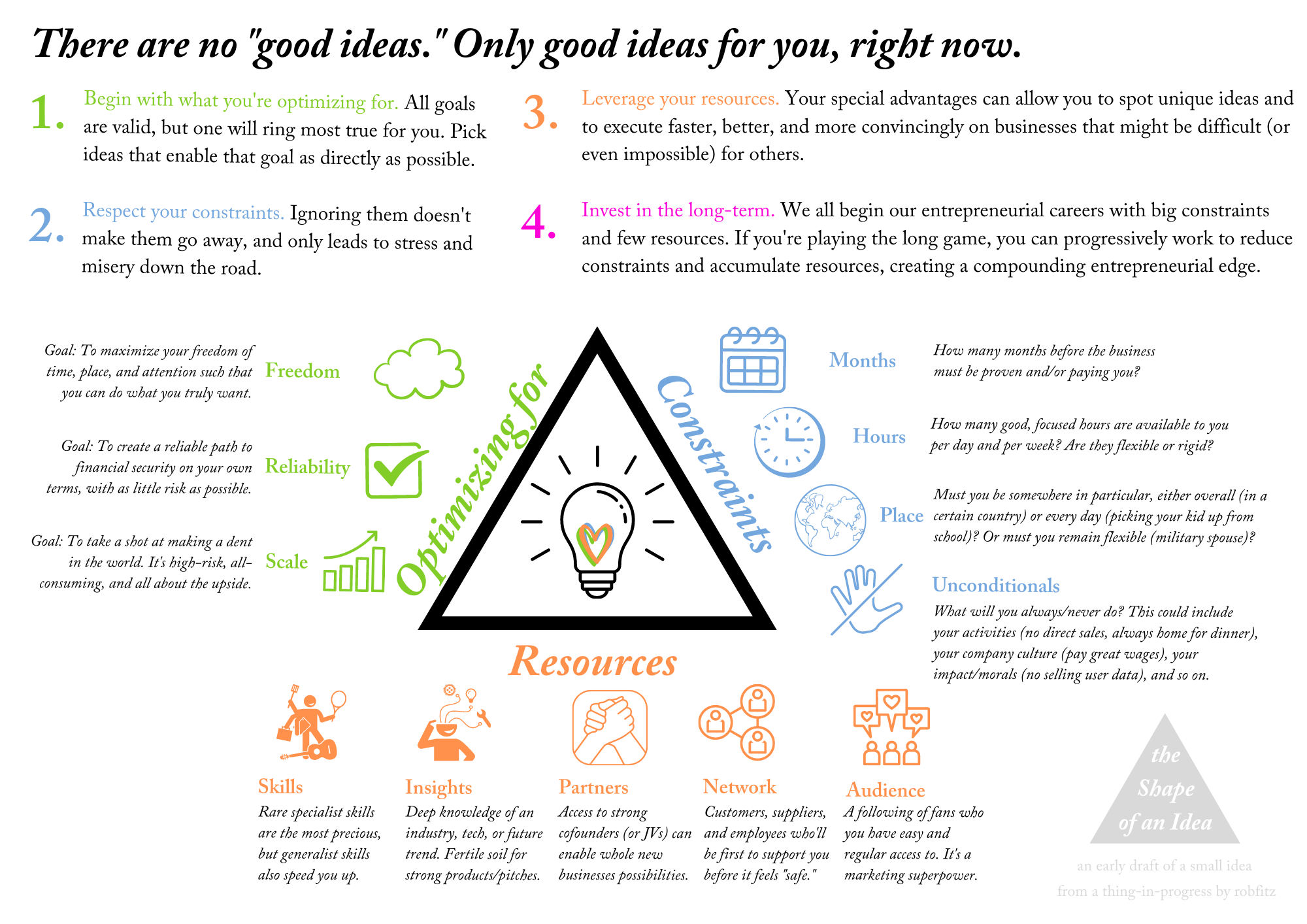
Some notes:
- “Reliability” is a bad label, but it’s pointing toward the situation where you need a high likelihood of success (young kids, debt, etc.) and are willing to sacrifice some upside and/or freedom to get there
- “Resources” can also be thought of as “edge” or “unfair advantage” at a founder-level. You combine your resources with those of your cofounders, and they can make certain ideas much easier to get at.
- At its extreme, the resource-focused approach to idea selection ends up fairly close to the bird-in-hand principle from Effectuation (and optimizing for reliability gets to their affordable loss principle)
This is a helpful tool for mentoring/coaching conversations. Many mentors begin with the incorrect assumption that every founder is optimizing for scale and lacking any constraints or resources. Before giving any advice, begin by figuring out the founder’s goals and context.
I’ve been using a simplified version of this with my cofounders and employees, with just three questions:
- What’s your main goal for this job/business (i.e., what you’re optimizing for between freedom/reliability/scale?)
- What has to happen for this to work for you? (i.e., constraints, usually involving time/place/money, but it varies)
- What are the values that make you excited and proud of the work you’re doing? (this is a second question within the constraints bucket, but from a positive bias of values/unconditionals rather than a negative bias of requirements/needs; most people don’t know the answer offhand, but you can tease it out by asking about rewarding past experiences)
Comments (21)
I think most people are actually "satisficing" not optimizing due to the computational complexity, cost, and time needed for a true optimization effort. They accept the first viable solution that satisfies key constraints, or may choose among two or three that are satisfactory. I think it's rare that they actually identify all of the feasible solutions and pick the best, few have the time (patience) or money.
You're right, I need to find a better label for that (and also "reliability," which most people don't understand as a guiding goal).
I originally had that optimization category called "goal," but that prompted too-long time horizons, since people kept saying that they wanted all three "eventually."
Or they'd say something like, "I'm building for scale because I want to get rich and have freedom," which is just the absence of a decision.
I changed it from "goal" to "optimizing for" in an attempt to create a more immediate time horizon (and also to make it feel more like a "pick one" scenario), but that has obviously added other issues. Words are hard ;)
Hey Rob, instead of 'reliable' I'd go with 'predictable'. It better captures the future state of an investment.
That's a good shout, actually. I'll use that 😁
Where is this coming from? or inspired by? i like this 👍
I re read this a few times I’m now thinking some freedom (in the of sense as in freedom of how spend time and in the from sense as in freedom from having a boss for eg) can be dependent on what you call reliability depending on one situation. So there might be some interdependency of some of these factors to optimize for.
Eg. certainty (or what you call reliability) of success * size of success - (cost of time or efforts or energy) can give a value that captures a lot of that freedom a person is optimizing for.
I need to find a way to clarify this, but it's supposed to be about what happens *during* the business, not after it. So for example, working on a bootstrapped micro-SaaS by yourself will give more flexibility *during* the business than a VC-funded hypergrowth company. And both micro-SaaS and hypergrowth tend to be more risky than something like a productized service, which is more reliably able to succeed (but with less freedom or scale).
A bit of effectuation, a bit of common sense, and a bit of lessons learned ;)
> *during* the business, not after it
Oh, yeah that's another useful dimension to consider. You should add that in.
On the other hand, i feel like building on top of yur framework in v1 and add a second bigger triangle. Like onion.
So for the optimize side, my second layer would be a multi-variate function.
Where it explicitly spells out a few factors and then i give a label to the outcome. Say, autonomy.
I had a v similar question to
. Putting in DURING business changes everything. Sounds like the freedom axis is mostly about lifestyle/time freedom while building it, whereas predictability is about steadiness of income while building it (although productized services, from what I've hear, can have a faster ramp but more variance than any SaaS?).
So my takeaway as of now is:
- freedom: time/lifestyle freedom while building biz. Micro SaaS likely slower ramp of revenue but pretty stable once going.
- predictability: a (productized) service probably better here for fast and more reliable revenue, but harder to scale up and less time freedom, because clients.
Am I grokking that right?
> faster ramp
Slight digress. This point inspires me.
Maybe it's the pedant in me talking here.
Thanks to this point, I feel like also adding a minimum acceptable height to ramp up to.
E.g. i have two possible ideas: one is productized services and another is SaaS
productized services idea has a faster ramp, but it has a far lower ceiling than the SaaS. and for my goals/lifestyle, the ceiling is such that it will always be below my Minimum Acceptable Height.
So if i write my points down during planning phase, i know i want the ramp to be similar to the productized services idea but with a similar ceiling as the SaaS idea. This then pushes me to look for a 3rd option. Maybe some combination of two or tweaks of either idea.
Sorry for sounding abstract. I am talking out loud for now to help me think.
Exactly, yes, that's how I think about it.
Beyond the big freedoms of time and place, some other under-appreciated flavors of freedom are:
• freedom from stress and urgency (hard if you have high-stakes sales or high-priority customer support)
• freedom to quit or change your mind (hard if you raise funding, hire employees, and/or invest heavily in infrastructure/R&D/assets)
• freedom to pause for a few months without worrying that the whole thing will collapse (hard if you are in a winner-take-all market, and/or a momentum-based industry like twitch streaming)
In my current business for example, we're working hard to avoid winner-take-all dynamics because we care strongly about maintaining the freedom to pause (for maternity/paternity leave, mental health breaks, hobby projects, etc.)
Awesome, thanks @ and .
your point about seeking a 3rd option to meet your criteria totally makes sense conceptually.
also sorry I was so short on the call today, I thought I had time and then all at once had 3 ppl urgently pulling me into a meeting. But I appreciated the short time I was able to be on the call!
I'm not familiar with effectuation — any guidance there? In what ways is that useful / what contribution do you find it makes?
It's a model for idea selection and strategy that seeks to maximize chances of success (as opposed to maximizing upside), which leads to some big and interesting differences from e.g. Lean Startup. The framework never really found a way to spread, but it's very solid, and a lot of old-time repeat founders follow at least part of its advice. To learn the basics, start with this list of principles: https://www.effectuation.org/?page_id=4055&principle=bird-in-hand
huh, interesting. Having explored both, what do you personally find useful from each / how have you merged the two in your practice?
They have different starting points. Lean Startup assumes you want to go as big and as fast as possible, and that you're attempting to be "optimal" in that regard.
Effectuation assumes that you want to maximize your chances of the thing succeeding, and that you're willing to compromise heavily on idea selection and upside to get there.
Lean Startup has a company-focused approach (i.e., make this one work), all or nothing.
Effectuation has a career-focused approach, which I appreciate (i.e., make your entrepreneurial career work, even if the first company or two aren't exactly what you dream of).
It's a little bit like asking to compare a train with a submarine — both useful machines, just built for different environments ;)
thank you, that makes sense
Hey Rob, love this discussion: idea selection in the context of life.
It inspired me to think - who's life we are talking about? founder life, customer life, idea or venture life, or All of them?
I sense that this is a continuous flow going on with these subjects, objects, and environments. Some we can control; some we can't. Look like how many founders allow their life to be disruptive to be unbalanced or chaotic in order to give fuel & resources to bring new idea to life. When ideas are materialized into the products or services and win their own customers, product earns its customer favor in utility. You earns customers trust from multi-interactions. Both products and us eventually lose its original trust channel from customers if we don't invest in interactions.
In order to face this million dollar question - "is this good idea for me to pursue?" Right now, i simply start with 3 questions first.
1. Am I still hesitated or on-fire? How much passion credits I would love to give? (Give a week to test it, maybe? 😂 )
2. Is this something you are willing to lose money & time?
3. If things become unbalanced or chaotic, can you figure out how to stay in the game longer?
Not sure whether this is a right analogy, but I will say it anyway. Like playing the simulation game, we are 100% sure to be in fail state or not optimized state. But we are willing to try it again and hope to increase our success in next round faster and smarter. 😀
Great perspective, and I think you're approaching it well. Seems like a holistic, thoughtful, and intrinsically motivated way to make the explorations/decisions.