Vanity engagement in Outcome-Oriented Communities
A definition:
Vanity engagement is anything that shows up in your metrics dashboard without correlating to member success.
A simple example is shallow-but-active forum posts about tools and tactics. In the Nonfiction Authors’ OOC, despite actively muffling (or at least 🔒not incentivizing) these types of conversations, the three highest “engagement” posts right now (purple highlight in the image below) are all about exactly this sort of trivia. Folks are contributing to these threads not because they are important, but because they are easy:
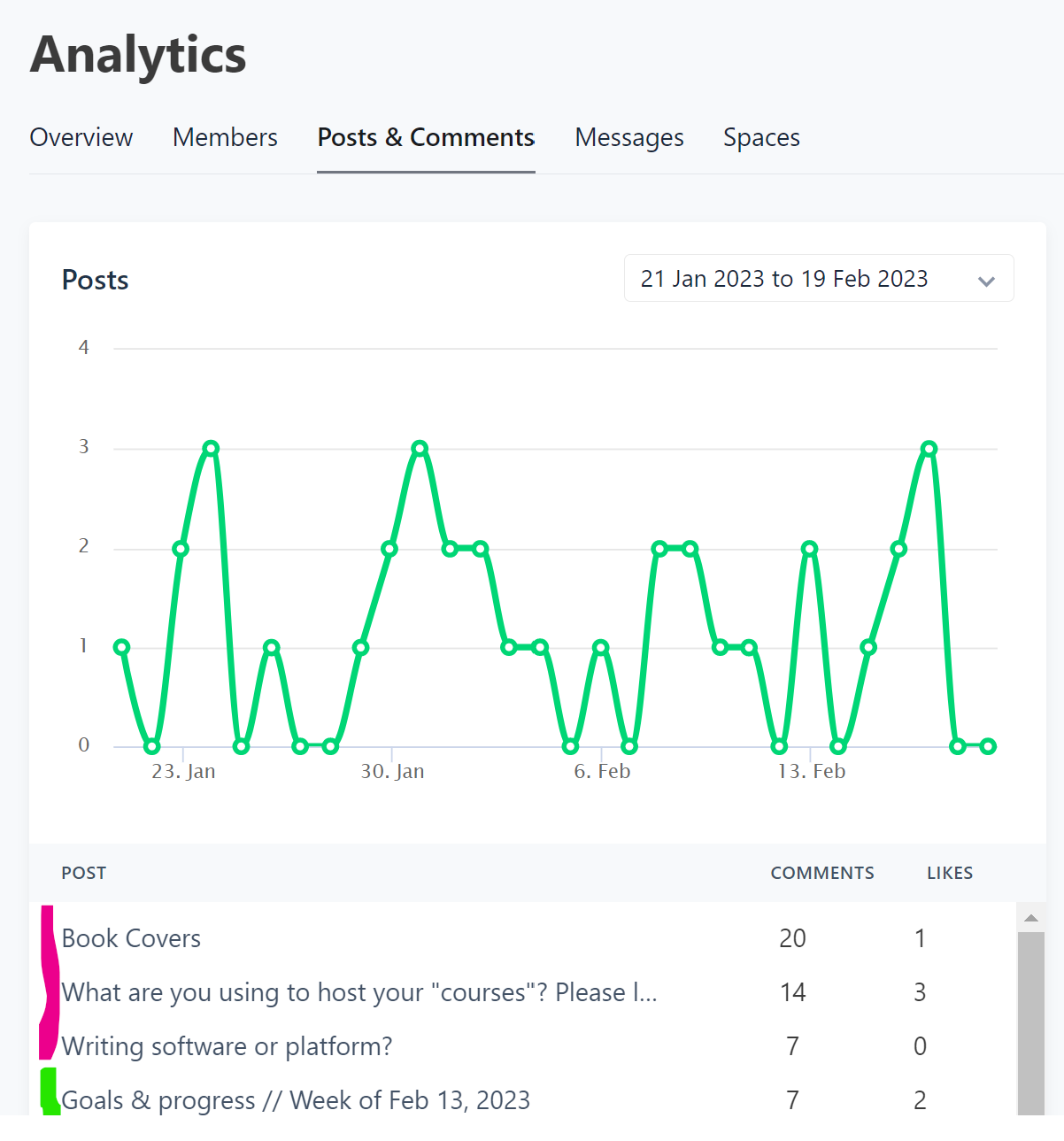
If we blindly followed the metrics (believing that quantity of discussion equals quality of impact), then we’d end up doing what every content site ends up doing: lots of tactical, technical, ephemeral opinion-fests. We would become a place where people talk about writing, as opposed to a place where people write; the more serious authors would drift away and the death spiral would begin.
In an OOC, practically any metric can become vanity engagement: educational content; event attendance; weekly check-ins; newsletter opens; forum contributions; etc.
It’s not just the 🔗bike-shedding posts either. Our most active forum users are not necessarily our most successful authors, and some of our zero-engagement members have gone on to successfully finish great books. So you could argue that basing any of our decisions on the pursuit of forum activity is an example of chasing vanity engagement. Even our Writing Accountability Groups, which do correlate with member success, shouldn’t be blindly maximized. (Non-attendance often just means that a member’s writing is going great, or that their kid is home sick, or any other number of reasons far more important than our own little metrics.)
You don’t want these metrics to be fully zero (and if they are zero, you probably have a problem that requires emergency intervention, since it means the 📘system is broken), but you also don’t want to be maximizing them, or really letting them influence your decision-making at all.
From 📝the early manuscript:
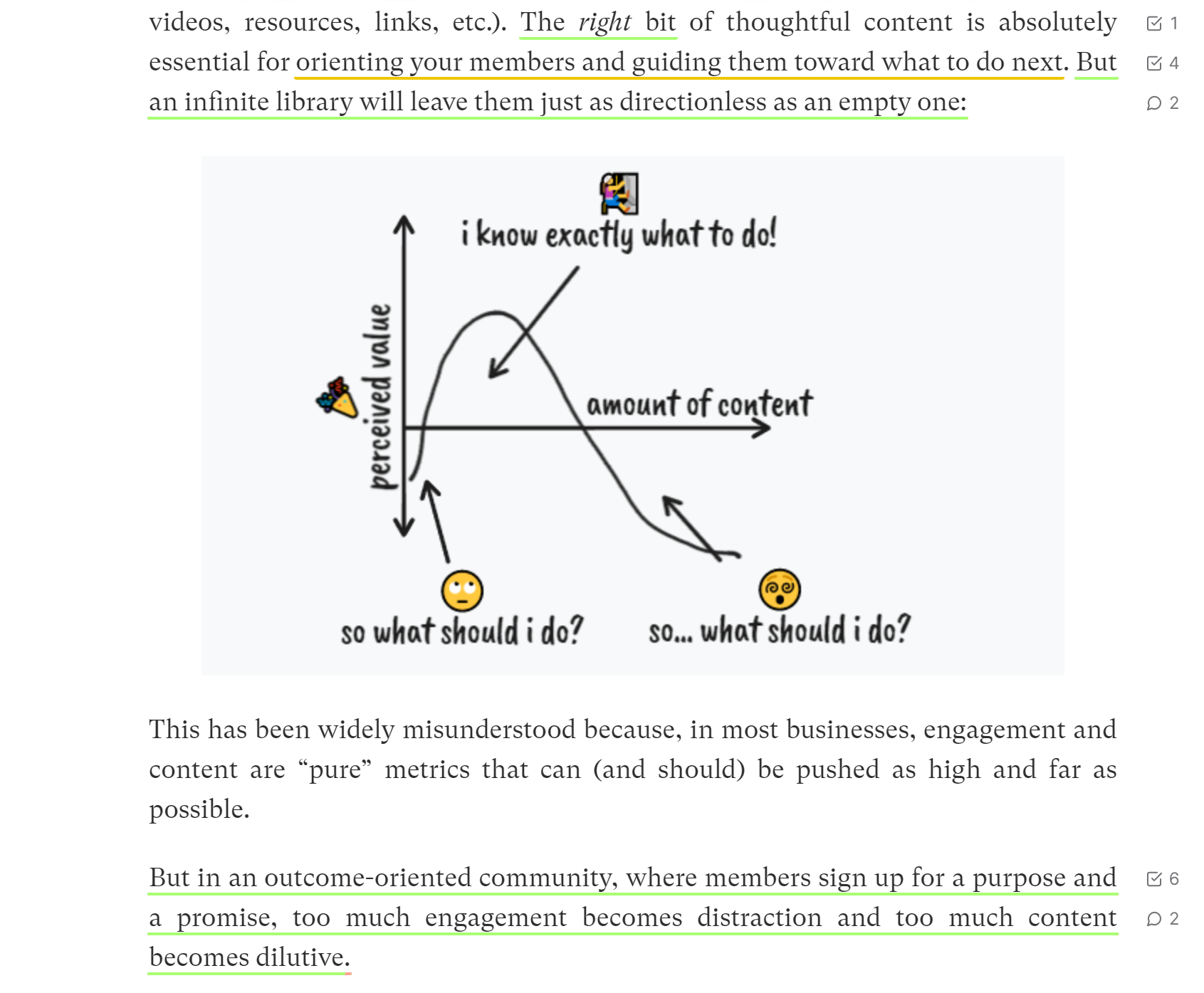
The appeal of chasing vanity engagement is that it feels weird doing nothing. But as we know from watching 🔗interventionistas in all fields, doing “something” often carries second-order consequences.
(Note: If you folks building “community” on twitter, and even on their own sites and forums, they’re frequently focused on creating exactly this sort of vanity engagement via polls, question of the day, ephemeral content, and other ways of making numbers to go up without helping members go forward.)
The “something” you should be doing, in an OOC sense, certainly isn’t to drive shallow engagement via easy questions 📘or loads of “just-in-case” content. Rather, it’s to grok the 🔒members’ goals and context, understand the workings of the system you are incrementally building, and figure out how to 🔒help with the hard part.
Comments (3)
Its tricky. I remember Merlin Mann writing about Distractions http://www.43folders.com/2010/10/05/distraction and "First, Care" http://www.43folders.com/2010/02/05/first-care
Here is my paraphrase of his key points:
• Do one thing at a time that you care about. Priorities are felt and focus is easy when it's on something you care about.
• Attack root causes not symptoms. I think the "bike shed posts" are embraced as a distraction by folks who don't want to deal with root causes. I think you have to propose topics that require honesty and personal examples, not glib summaries of Wikipedia articles or "roundups of roundups" (what Sean Blanda called "The Bullshit Industrial Complex" https://www.behance.net/blog/the-creative-worlds-bullshit-industrial-complex ) or ChatGPT generated summaries.
• Embrace constraints- acknowledge what cannot be changed and treat it as a fact. “If you have the same problem for a long time, maybe it’s not a problem. Maybe it’s a fact.” - Yitzhak Rabin
• Use good enough systems to get work done. Resist temptation for perpetual improvement loops that as a byproduct avoid getting real work done. Key is a punctuated equilibrium model where you alternate periods of focused experimentation with focused execution.
I am sorry if I come off as glib but I think our obligation as community leaders is to encourage members to focus on the real work that can be done with imperfect tools and painful constraints.
Interesting. And quite topical for us at the moment as we're going through a bit of a lull from a content perspective in MicDrop. One thing one of the members brought up (who is a v successful community builder in their own right) is the use of a Whatsapp community to supplement what we have on Circle.
The Whatsapp community for small talk and member connection.
The circle as the community hub which is all around mastering the craft.
I'm part of another network that is highly engaged that has something like this that uses both a forum and a telegram group to achieve the same effect.
Does anyone in here have a similar set up? If so has the extra additional resource been a net positive or negative?
Our biggest concern is too many things - I like the simplicity of having everything in once place and having an additional chat may be confusing. That said, people aren't jumping into the hub very much at the moment which is something that I'm conscious of.
They are however attending the online events so it's not like there isn't any engagement at all.
I did some wondering about chat/forum hybrids (since a number of communities do seem to do it, and a number of members do seem to request it) here and here. On the one hand, the fragmentation hurts. On the other, people definitely do talk "differently" in posts vs. messages. In the authors' community, I'm going to be spinning up chat spaces (within circle, even though it's fairly limited) for temporary purposes such as a writing sprint, or as invite-only sub-groups that don't clutter the spaces (like community volunteers). There's no ironclad rule prohibiting a spread across multiple services (even in this small group, there was a subgroup that interacted primarily via the live events, and another that interacted primarily via the forum), but as someone trying to run these things for a bit, I definitely felt that each additional tool added a certain amount of admin overhead and upkeep. So if I have the choice, I'll opt for fewer tools/platforms.