Casting a wider net to catch member success stories from multiple sources?
Both Sierra (BADASS) and Skrob (Retention Point) describe member stories as a sort of community gold dust, used as a core ingredient of everything from marketing pages and onboarding emails through to the weekly email heartbeat.
But they’re kind of hard to gather, especially when member progress happens out in the real world.
A while back, Jose vented some frustration over the common pattern of “mandatory” (or at least strongly incentivized) standups/checkins within community, feeling that it was more speedbump than value.
We implemented them as an optional thing in the Authors’ group via a weekly, automated accountability thread, on the basis that responding with a comment might be less off-putting than originating a whole new post. That basically worked, but the engagement is quite spikey, with weekly comments ranging from 30+ to as low as 4:
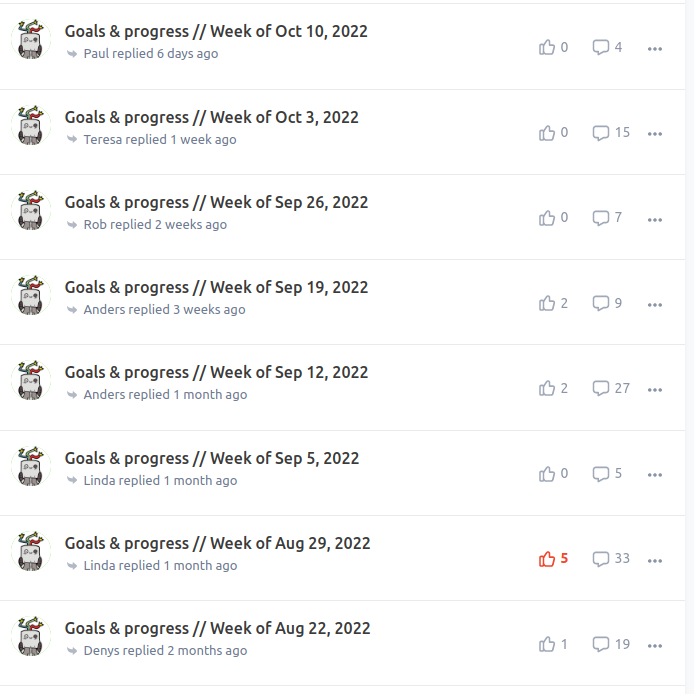
While I wouldn’t want to force everyone to do this sort of task against their will, overly low engagement does risk becoming a vicious cycle of localised ghost town.
Enter the “Wins and milestones” section of the email heartbeat: beyond showing off the week’s member success (to help incentivize the behavior change and values), the inclusion also demonstrates to new members that if you do want to participate, you get a little shoutout:
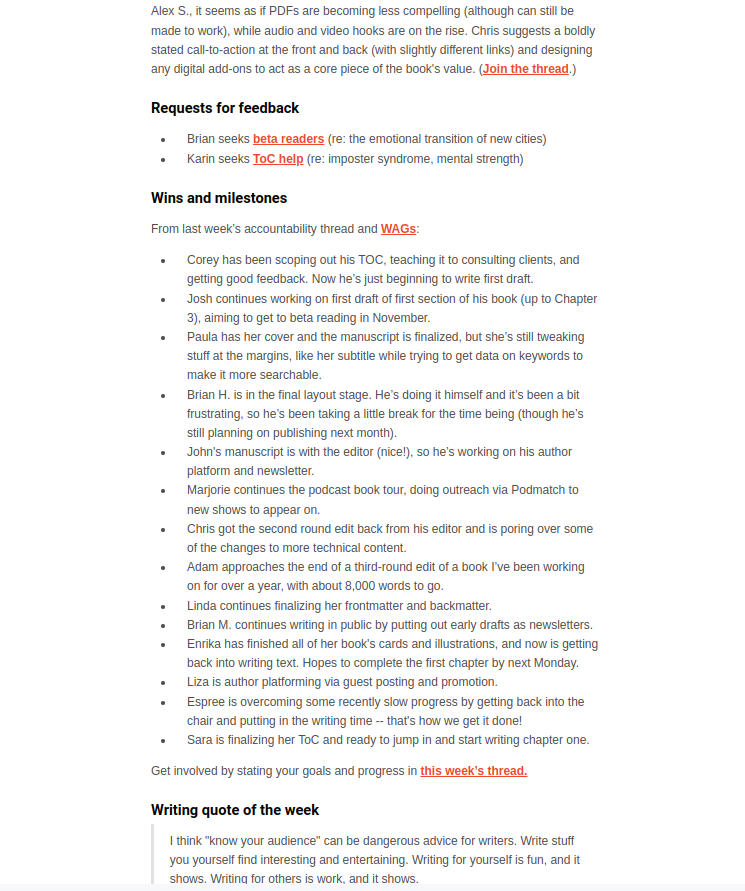
But every so often (such as the last two weeks), activity in the Circle thread has been insufficient to fill the email with enough member success.
So something we recently started is to take written notes of our members reported progress during live events. It took us a while to get to this solution, since it feels so wildly low tech, but it works! Even without needing to screen record anything (a big part of these writing group is about sharing challenges and vulnerability), we get a set of additional member successes for each live event.

By having the accountability thread + event notes, we’re casting a wider net and allowing ourselves to catch more examples of member success. Which is then helpful all over the place.
And in combination with our signup segmentation survey, we’re starting to get a legitimately insightful view of where folks are up to – and how they’re progressing – along their member journey.
Still, I’m on the fence about whether to take this even further… For example, we could relatively easily be scraping Amazon to know exactly when our members have published a book or received their first five-star review. Or we could (and actually already have) compile a Twitter list to watch their efforts while “writing in public.” The member stories would be amazing, but I don’t want it to feel like we’re stalking folks or sharing stuff that they didn’t want to share, even if it is technically public info. did it really well, I thought, but it’s an admittedly delicate line to walk. (Or maybe I’m just overthinking it and everyone would always love it!?)
So with some details still to be determined, I feel fairly confident saying that it’s probably a good thing to catch member success stories from at least a couple sources, and not to over-rely on just one.
Comments (6)
Jared Spool talks about a category called inukshuk which is day to progress (or signposts marking your path). Consider a weight loss group: I think you need to support both planning and tracking. How far have you come -- how much weight have you lost--is tracking. It's an important calculation to help maintain commitment. How long will it take to reach your goal, how far are you from your goal, involves planning.
Applying this to Bootstrapper Breakfast, here is my first pass at some milestones / progress markers:
• Customer interviews (in last week, month, quarter)
• key insights from interviews
• first dollar of revenue
• first dollar of profit
• first dollar you have taken out of the business.
I love celebrating the first dollar taken out as a milestone.
I've noticed that only certain types of people find intrinsic motivation for sharing these sorts of progress updates. IndieHackers (and many running communities) deal with it by asking folks to do a one-time integration with the data source itself (i.e., Stripe or RunKeeper, respectively), which removes the need for ongoing self-updates.
But for more qualitative stuff like BSB and the authors' group, the auto-update doesn't seem to have as much power. (Especially for non-Americans, who can be more resistant to announcing their own progress.)
I've wondered about using public member tags as a sort of aspirational trigger to share progress (i.e., by sharing your progress, you also get the updated tag). We put a few in place as an experiment (like "Beta Reading" or "First Drafting" or "Published!"), but nobody has asked about updating them, which makes me feel that the tags aren't especially motivating.
Some shares are also inherently self-promotional, which feels a lot more reliable. E.g., of all the milestones in the authors' community, the two that are most actively announced are (1) beta reading and (2) publication. Which are also, by no coincidence, the moments when an author is most interested in drumming up additional external attention. (IndieHackers also gets a lot of mileage from the motivations of healthy self-promotion --- or at least, it did in its heyday.)
So I guess there's a question of trying to pin down what the member "gets" out sharing each particular bit of progress, and then either:
1. Leverage the existing intrinsic motivation (often some flavor of self-promotion or feedback/support, I'd imagine)
2. Gather the data from a reliable external source (like RunKeeper or Stripe or observations on social media...?)
3. Craft or engineer an incentive to make the share more desirable
#3 is clearly the murkiest and most ambiguous, but maybe also necessary in many cases.
One option we've been considering is to try to catch people between beta reading and publication for a 10-20m video interview, on the basis that we get their success story, and they get a bit of exposure for their book and a nice video clip to use on social media for promotion. Members are really keen on this, but there's some execution challenge to getting good footage (I did one as a trial that ended up being completely useless).
So I guess I'd say: do #1 or #2 (intrinsic incentives or observed data) where possible, and #3 (designed incentives) where necessary?
Yeah, I think these things must have something that they "get out" of it beyond simply sharing, else it feels arbitrary. And I think that includes (most) engineered, gamified-type solutions.
Of course, that does include simply getting support (sometimes solution-oriented, sometimes "at least I don't feel so alone!"), celebrating, self-promotion, etc. But those have to be genuine.
Re: ghost towns on dated check-ins, I guess I wonder, why even date it? I understand the intent is to reduce the significance from full-fledged post to simply commenting, but that's doable without posting only as a date. I'm thinking of old school forums where you'd close a thread when it reached a threshold of posts, and then open "the same topic thread, #2" and then #3 and so on, simply for the sake of the thread not being completely overwhelming after a certain number of posts. And the locked, archived threads would be linked in the first post of the new thread for folks who do feel like going on a deep dive on the topic. These could indeed be topical, like checking in on a particular milestone or challenge along the journey.
I guess the drawback is that it has less of a "regular heartbeat" component, and also therefore potentially a lesser source of user success stories for things like e-mail newsletters, etc.
But I don't know... is an arbitrary thing, just to have success stories on tap, really necessary?
I want to suggest a perspective for metrics and customer testimonials / success stories.
You need metrics to determine if the methods you are advising community members to try are actually helpful: where are they particularly effective and where are they contraindicated?
Anecdotes are also helpful in this regard because they can be early indicators of the potency or efficacy of a particular tactic (or recipe) as well as harbingers of the limits or drawbacks to a tactic or course of action.
To the extent we are committed to improving our advice / knowledge / practice we need to be committed to gathering these, and other members of the community can help. Some advice might be labelled as experimental or part of an ongoing study or experiment, in which case asking for data on it's efficacy is reasonable. So is reporting on the results observed or outcomes achieved on a regular basis.
Member stories are also very helpful in answering the question a prospective member is likely to ask: what results can I expect in a particular time frame?
I think if we anchor this discussion in improving our practice and helping members improve, and in answering realistic questions from prospects, we are well served.
My answer to is that "success stories" are essential, as is well curated data, to your ability to make promises that you can keep.
I agree that it's essential; I'm not sure it's essential on a heartbeat basis, especially if reaching for that leads to arbitrariness that doesn't actually serve the community members.
I think "Success stories" are a byproduct of our desire as community leaders / practice leaders to figure out what's working and to continually offer improved methods and experiments in addition to the "tried and true." I agree we should not be "annoying" or pestering people for success stories as much as asking people on a regular basis what they have learned that has made them more effective. In the case of the Bootstrappers Breakfast, more effective as entrepreneurs. In your community, more effective at mitigating chronic conditions and the cost and effort required to effect those mitigations.